
When is the last frost in your area? There is no official date: the Met Office does not publish an average last frost date for any place, only the pattern that the last air frost often comes before the end of April in the south and on coasts, and well into May (in a few places June) in the north and on higher ground.

For planting out tender crops such as tomatoes, beans, courgettes and basil, a more useful guide is the RHS's regional planting-out timing, which runs from the first half of May on the south coast to early June in north-east England. This page shows how to combine that, the Met Office station data and your own garden to make a sensible call.
When is the last frost in my area? Start with the RHS regional guide
The RHS gives typical first safe times for planting out frost-tender plants. These are later than the last air frost on purpose: the RHS says the last air frost usually comes two to four weeks before it is safe to plant out.
| Part of England | Typical first safe planting-out time (RHS) |
|---|---|
| South-west tip and south coast | First to second half of May |
| Southern England | Second half of May |
| Midlands, north-west England and Yorkshire | End of May |
| North-east England | Early June |
Then adjust for your site, again following the RHS:
- Sheltered, urban or coastal gardens: 1–2 weeks earlier.
- Exposed, rural or high gardens: wait 1–3 weeks longer.
- Frost pockets: plant later, or avoid them for tender crops.
The RHS also gives a temperature test: plant out when nights are consistently above 7°C. It adds that tomatoes, peppers, basil and cucurbits (courgettes, cucumbers and their relatives) do better once nights stay above 10°C.
Its older frost-damage page gives a coarser schedule (early May for London and the south-west, mid-May for southern England, late May for much of England) that differs slightly from the table. Use the table above and treat both as averages, not guarantees.
What the Met Office data says
The Met Office publishes long-term averages for individual weather stations, including the average number of days of air frost in each month. These are counts of days, not dates, but they show how different places are. Here are three stations in England, using 1991–2020 averages.
| Station | March | April | May | June | Year |
|---|---|---|---|---|---|
| Teignmouth (Devon coast) | 1.18 | 0.17 | 0.00 | – | 11.06 |
| Oxford (southern inland) | 3.80 | 1.43 | 0.10 | – | 33.73 |
| Shap (Cumbria, upland) | – | 6.80 | 4.14 | 0.37 | 71.06 |
A dash means the figure is not in our source data. Read it like this: on the Devon coast an April air frost is rare and May averages none; at Oxford, May averages just a tenth of a day; at Shap, high in Cumbria, an average May still has about four air-frost days, and June has a fraction of one.
Two more points from the Met Office and the RHS. The average last frost has been moving earlier as the climate warms, and the RHS notes that frost days have fallen in recent decades. But late frosts still happen: April 2021 had the most April air frosts in at least 60 years.
Last frost date by postcode: why there is no reliable figure
Many people search for a last frost date by postcode, and it is a fair thing to want. The honest answer is that the Met Office publishes no average last frost date for a postcode, a town or a region. If a website gives you a single date for your postcode, treat it as an estimate, not a Met Office figure.
What to do instead:
- Find your region in the RHS table above.
- Adjust for your site: earlier if you are sheltered, urban or coastal; later if you are exposed, rural, high or in a hollow.
- Look up the nearest weather station on the Met Office's location-specific long-term averages pages to see how many air-frost days it averages in April and May.
- Watch the forecast in the weeks before you plan to plant out, and keep fleece ready.
Is there a last frost calculator?
Not one that can promise a frost-free date for your garden. The four steps above are the calculator: a regional starting point, a microclimate adjustment, local station data and the forecast. They take a few minutes and give you a planting window rather than a false single day.
Air frost and ground frost
These are different, and the difference matters for seedlings.
- Air frost: the Met Office defines it as air temperature falling to or below 0°C, usually measured at least 1 m above the ground.
- Ground frost: forms on the ground, plants and objects whose surface falls below freezing. It can happen without an air frost, because the ground can cool faster than the air. Frost on the grass while paths stay clear is a ground frost.
The Met Office says ground frost is more common than air frost in May. The RHS adds that ground frost can form on nights of 1–4°C, even after the last air frost, and can kill tender plants or hold them back for weeks. Young plants in a raised bed sit close to the soil surface, so this is the frost to watch for.
Frost pockets and your microclimate
Cold air sinks. The RHS explains that it flows downhill and collects at the lowest point, or builds up against a barrier such as a hedge or fence. A garden at the bottom of a slope, or a bed tucked against a solid fence on the downhill side, can hold frost when the rest of the street is clear.
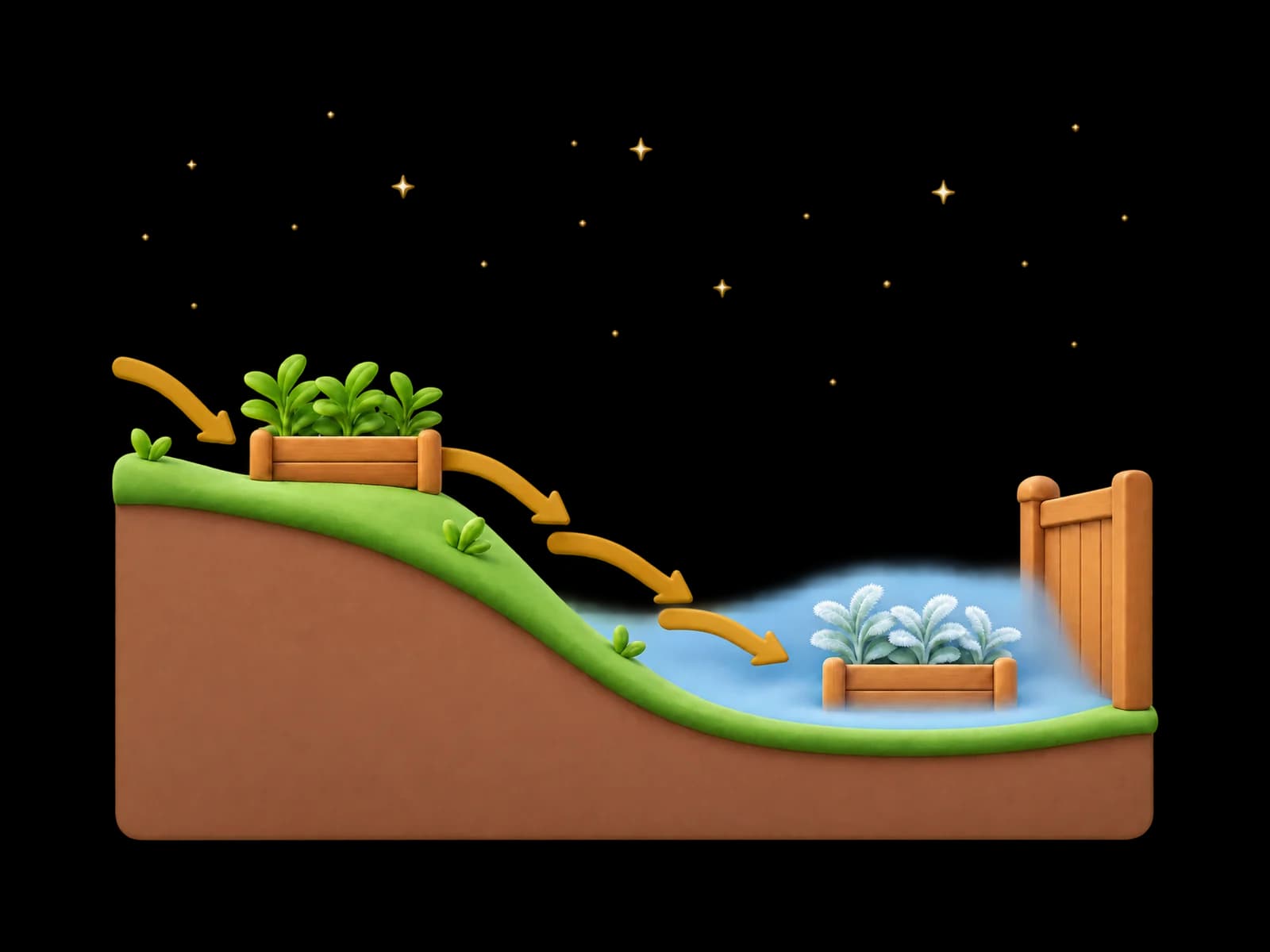
The Met Office notes that valleys are especially prone to frost, and that frost is more common in the countryside than in towns, which hold more warmth. To reduce a frost pocket, the RHS suggests making a gap in the barrier or thinning lower growth so the cold air can drain away. Otherwise, put tender crops elsewhere or plant them later.
How to judge frost risk on your own site
You do not need special equipment. The Met Office gives a simple rule of thumb:
- Clear and calm night, forecast air temperature 0–4°C: frost is possible, and more likely the closer the forecast is to 0°C.
- Surfaces run colder than the air: leaves, soil and bed edges can be a few degrees below the forecast figure.
- Cloudy or windy night: usually frost-free.
Keep a note of the first and last mornings you see frost on your own bed each year. After a couple of seasons you will know whether your garden runs ahead of or behind the regional guide. If a cold night is forecast after planting, cover tender plants: the RHS says heavier fleece gives about 2°C of protection, and a double layer helps on the coldest nights.
Hardening off before planting out
Plants raised indoors need time to adjust to outdoor conditions before they go into the bed. The RHS is clear that hardening off does not make frost-tender plants hardy; it only stops their growth being checked by the move.
The RHS gives two different figures. Its hardening-off guide allows two to three weeks, and longer for plants raised in warmth; its May jobs page says 10 to 14 days. If you have the time, the longer period is the safer choice for tomatoes, peppers and other plants raised warm.
Two RHS methods:
- Cold frame: in the first week, open the lid a little by day and close it at night. Over the next two weeks, open it further until it comes off before planting.
- Fleece: in week one, stand plants outside by day under two layers of fleece in a sheltered spot and bring them in at night. In week two, use one layer. Uncover them by day at the end of week two; by the end of week three they are uncovered and ready to plant.
Count back from your planting-out window so hardening off starts in time. For month-by-month timing, see what to plant in May and what to plant in June, and for crop detail see how to grow tomatoes and how to grow basil.
First frost date in autumn
The same caution applies at the other end of the season: there is no official average first frost date for England or for a postcode. The station averages show the spread. Teignmouth averages no October air frost and 0.62 days in November; Oxford 0.73 days in October and 3.17 in November; Shap already has 0.53 in September, 3.93 in October and 8.08 in November.
From late September, watch for clear, calm nights with a forecast of 0–4°C. Pick tender crops such as tomatoes, beans and basil before the first frost, and lift self-blanching celery before frost too.
How Sowstory handles frost
Sowstory's timing is set for England as a whole. It does not calculate a frost date for your address, and its sowing and planting months are not adjusted for your postcode's local climate. You enter a postcode only to place your bed in England, and the full postcode is not stored.
What the plan does is keep tender crops out of the bed until frost risk should be over. Outdoor tomatoes, cucumbers, courgettes, dwarf French beans, basil, peppers and chillies all start in the bed in June, and runner and climbing French beans from May to June after frost. Within those months, you still make the final call using the steps on this page.
If you want a plan that puts each crop in the right month and the right place in the bed, Sowstory lays out your bed to scale and gives you a month-by-month timing plan for England. It is coming soon to the App Store, and your first bed plan is free.
For the whole year, see the vegetable sowing calendar.
Sources
- Met Office: What is frost and ice?
- Met Office: Why frost can still occur in late spring
- Met Office: 5 gardening tips for May
- Met Office: Teignmouth climate averages
- Met Office: Oxford climate averages
- Met Office: Shap climate averages
- RHS: When to plant out tender plants
- RHS: Frost damage
- RHS: Hardening off
- RHS: Grow your own, May jobs
- Sowstory knowledge base, release v1.4