
There are no well-established cucumbers companion plants: neither the RHS nor Gardeners' World names any in their cucumber guides. What does make sense for outdoor cucumbers in England is a few open flowers nearby for pollinating insects and low, quick crops on the sunny side of the supports, while keeping ridge types away from all-female greenhouse cucumbers.
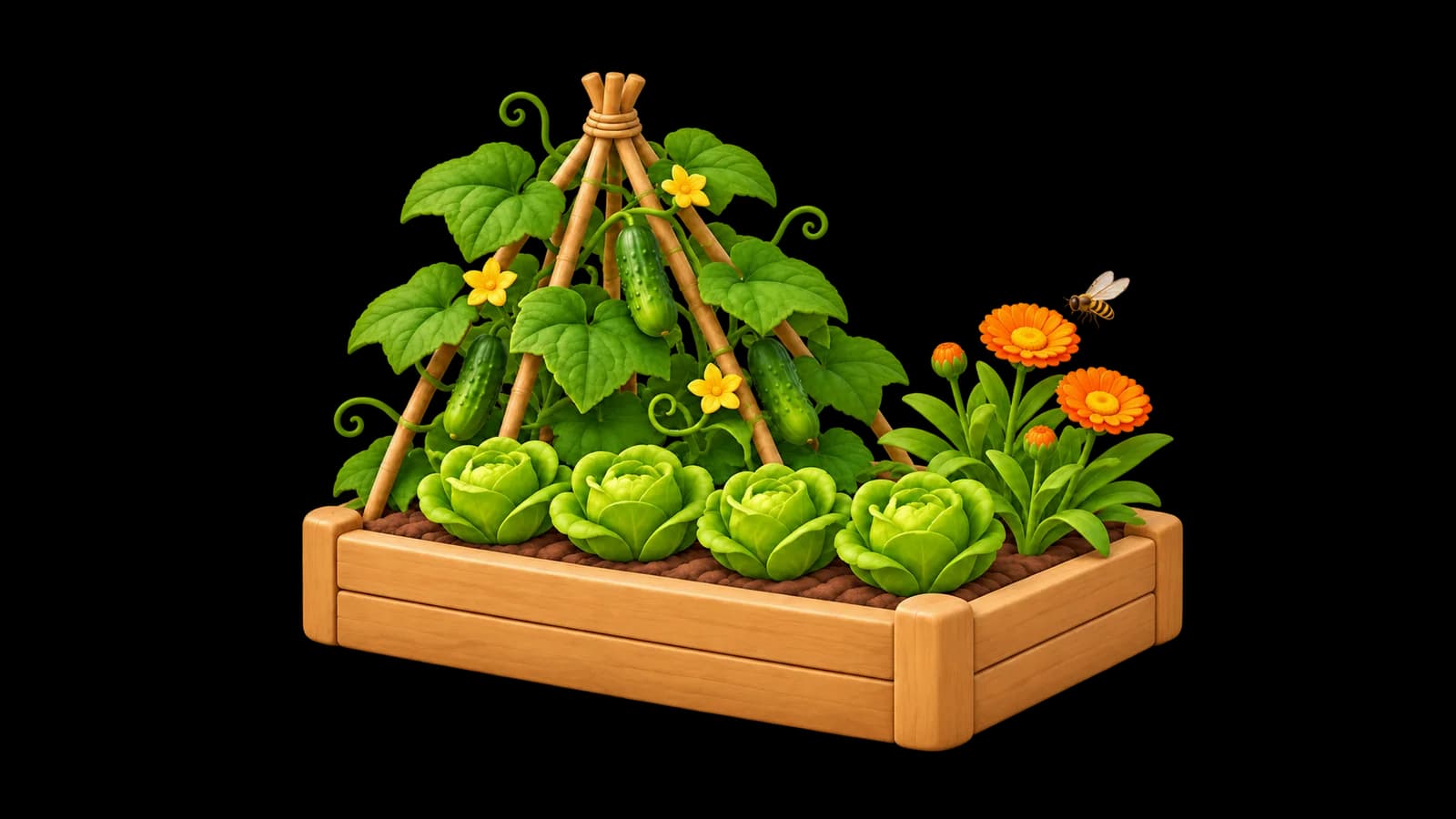
This page is honest about how thin the evidence is, then sets out the practical neighbour rules that do have a reason behind them, and how to lay out cucumbers in a raised bed.
Cucumbers companion plants: what the sources say
We checked the RHS and Gardeners' World cucumber guides and their companion planting articles. The cucumber guides do not mention companion plants at all. The only cucumber "bad neighbour" claim is on a Gardeners' World list that says to keep cucumbers away from potatoes, and the magazine itself describes that whole list as anecdotal.
That matches the wider picture. The RHS says companion planting benefits probably exist, but not for every crop in every situation. Gardeners' World describes the evidence for companion planting in general as largely anecdotal. For cucumbers specifically, we found nothing stronger, so the ideas below are labelled by where they come from.
| Idea | Why | Evidence |
|---|---|---|
| Open flowers near the bed | Outdoor cucumbers need insect pollination | Advice: pollination need is from the RHS; flower benefit for cucumbers not tested |
| Lettuce or other low, quick crops in front | Uses space before it is shaded | Advice (RHS space-saving principle) |
| Keep away from all-female greenhouse cucumbers | Cross-pollination gives bitter, seedy fruit | Advice (Gardeners' World) |
| Give plants space and airflow | Still, humid air and dry roots favour powdery mildew | Advice (RHS) |
| Keep away from potatoes | Not stated | Anecdotal (Gardeners' World) |
Companion ideas that make practical sense
Flowers for pollinators and hoverflies
Outdoor cucumbers are different from most greenhouse types. The RHS explains that outdoor varieties carry both male and female flowers, and the female flowers need pollinating to produce fruit, which is why you should not pick off the male flowers outdoors. Anything that brings pollinating insects to the bed helps that process.
Gardeners' World says calendula grown with courgettes, a close cucumber relative, draws in pollinators, though it gives no evidence. The RHS lists English marigold (Calendula) among good plants for hoverflies, and around 40% of British hoverfly species have aphid-eating larvae. A few calendula plants at the end of the bed are a low-risk choice.
Low, quick crops in front
The space-saving side of companion planting suits cucumbers well. Trained up canes or netting, a cucumber plant uses height rather than ground, which leaves the soil to its south free for quicker crops. The RHS describes growing fast crops such as lettuce and radish between slower ones and clearing them before they are shaded.
Lettuce works well here. Sowstory lets lettuce grow with four to six hours of direct sun, so it copes with a little shade later in the day. Our guide on how to grow lettuce covers sowing little and often through the summer.
What to keep away from cucumbers
All-female greenhouse cucumbers
This is the clearest cucumber neighbour rule, though it applies to greenhouses rather than beds. Gardeners' World warns against growing outdoor (ridge) types in a greenhouse alongside all-female greenhouse types, because cross-pollination gives bitter, seedy fruit. The RHS adds that on all-female greenhouse types any male flowers should be removed for the same reason.
Crowding and still air
The RHS names powdery mildew as one of the two main threats to cucumbers, with red spider mite. It says the mildew is favoured by dry roots combined with humid, still air, and that cucurbits grown against walls and fences are often badly hit. Its advice is to water regularly in dry spells, mulch, and space plants out. So do not squeeze companions tightly around cucumbers: give each plant its full space.
Potatoes (anecdotal)
Gardeners' World's anecdotal keep-apart list includes cucumbers with potatoes. There is no stated reason, but it is easy to follow in practice: potatoes need a wide row for earthing up, and they belong apart from tomatoes anyway because of blight. See potato companion plants.
Anything they will shade
Trained cucumbers are tall. Put them where their shadow falls off the bed, not across sun-loving crops such as tomatoes or basil.
Cucumbers and tomatoes in the same bed
Cucumbers and tomatoes are the pairing most people ask about, because they are planted at the same time and want the same conditions. None of the sources we checked says to keep them apart. Both are tender, both need at least six hours of direct sun in Sowstory's rules, and both go into the bed in June once nights are warm enough: the RHS suggests waiting until temperatures stay reliably above about 12°C for outdoor cucumbers and about 16°C for tomatoes.
The real competition between them is for the north edge. Trained cucumbers and staked cordon tomatoes are both tall, so both belong on the north side of the bed, and Sowstory allows about 60 cm of that edge for each plant. Along a 2.4 m bed that gives four positions in total, so you are choosing a mix, such as two of each, rather than a full row of both. Water them evenly: cucumbers suffer from mildew when their roots dry out, and tomatoes split or develop blossom end rot.
Laying out cucumbers in a raised bed
Sowstory plans outdoor ridge cucumbers trained up canes or netting. It treats them as a tall, supported crop and places them on the north edge of the bed, with a 60 × 60 cm square per plant and up to three plants per bed. The RHS spaces plants 30 cm apart on a cane wigwam; Sowstory uses the wider supplier figure so a single trained plant is not crowded. Sowstory does not plan trailing, unsupported cucumbers.
A simple summer layout for a 1.2 × 2.4 m bed:
- North edge: two outdoor cucumbers on canes or netting, plus one or two cordon tomatoes if you want both.
- Middle: basil or another low, warmth-loving crop in front of the tomatoes.
- South side: rows of lettuce, sown in batches.
- Bed ends: a few calendula.
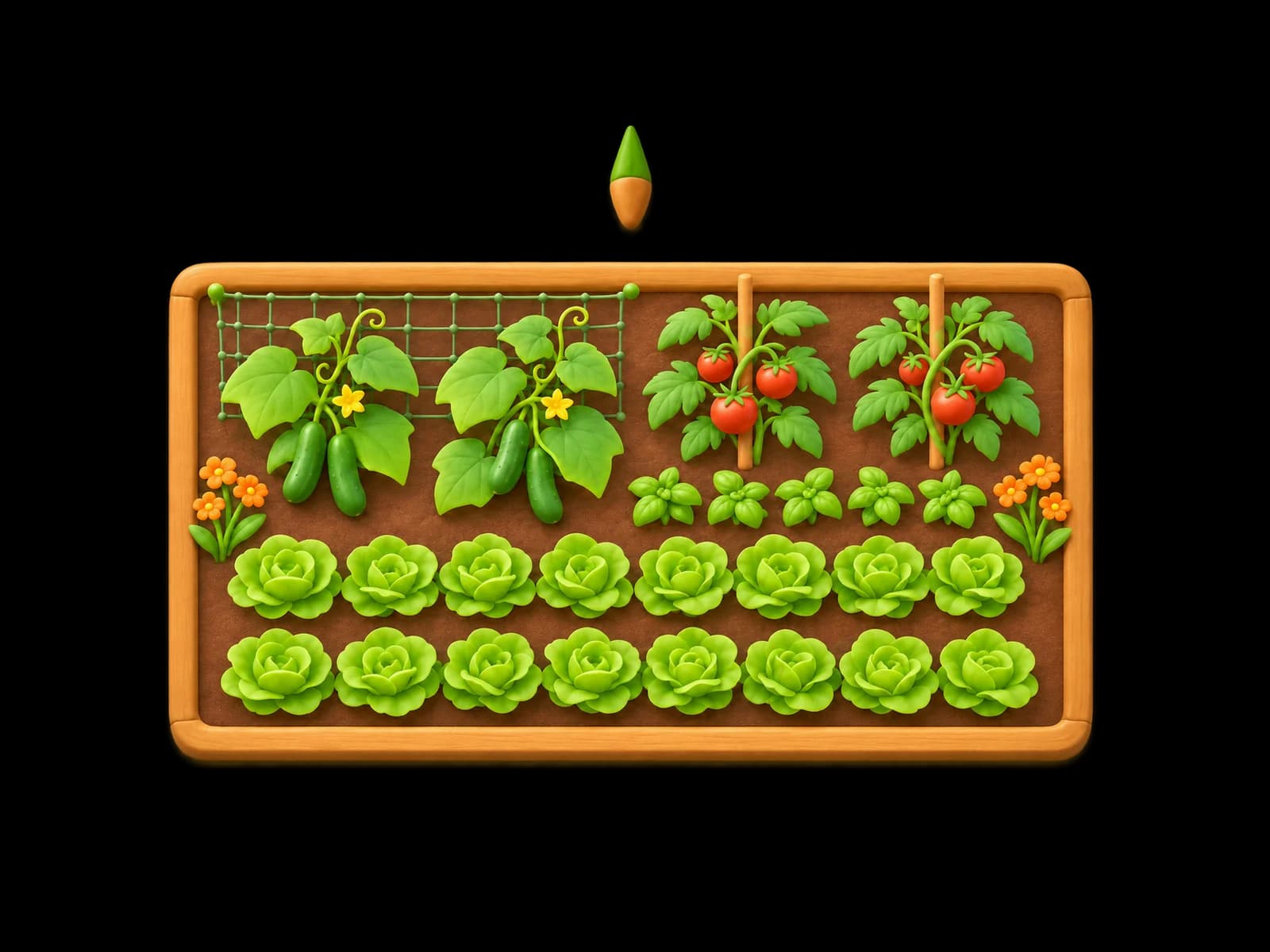
Check each crop's spacing in the vegetable spacing chart, and see more arrangements in our raised bed layout ideas.
Sowstory does not score companion pairings. It does place trained cucumbers and other tall crops on the north edge automatically, and works out how many plants fit your bed alongside everything else. It is coming soon to the App Store, and your first bed plan is free.
Rotation
The RHS says cucurbits, including cucumbers, can go wherever is convenient in a rotation, as long as they are not grown in the same spot too often. In a single raised bed, moving cucumbers to the other end each year is a simple way to do that.
For sowing, training and picking, see our guide on how to grow cucumbers. For other crops, the companion planting chart sorts popular pairings by evidence, and our page on companion planting tomatoes covers the cucumber's usual bed-mate.
Sources
- RHS: How to grow cucumbers
- RHS: How to grow tomatoes
- BBC Gardeners' World: How to grow cucumbers
- BBC Gardeners' World: Companion planting, best plants to grow together
- RHS: Three ways to use companion planting
- RHS: Powdery mildews
- RHS: Hoverflies
- RHS: Crop rotation
- Sowstory knowledge base, release v1.4