
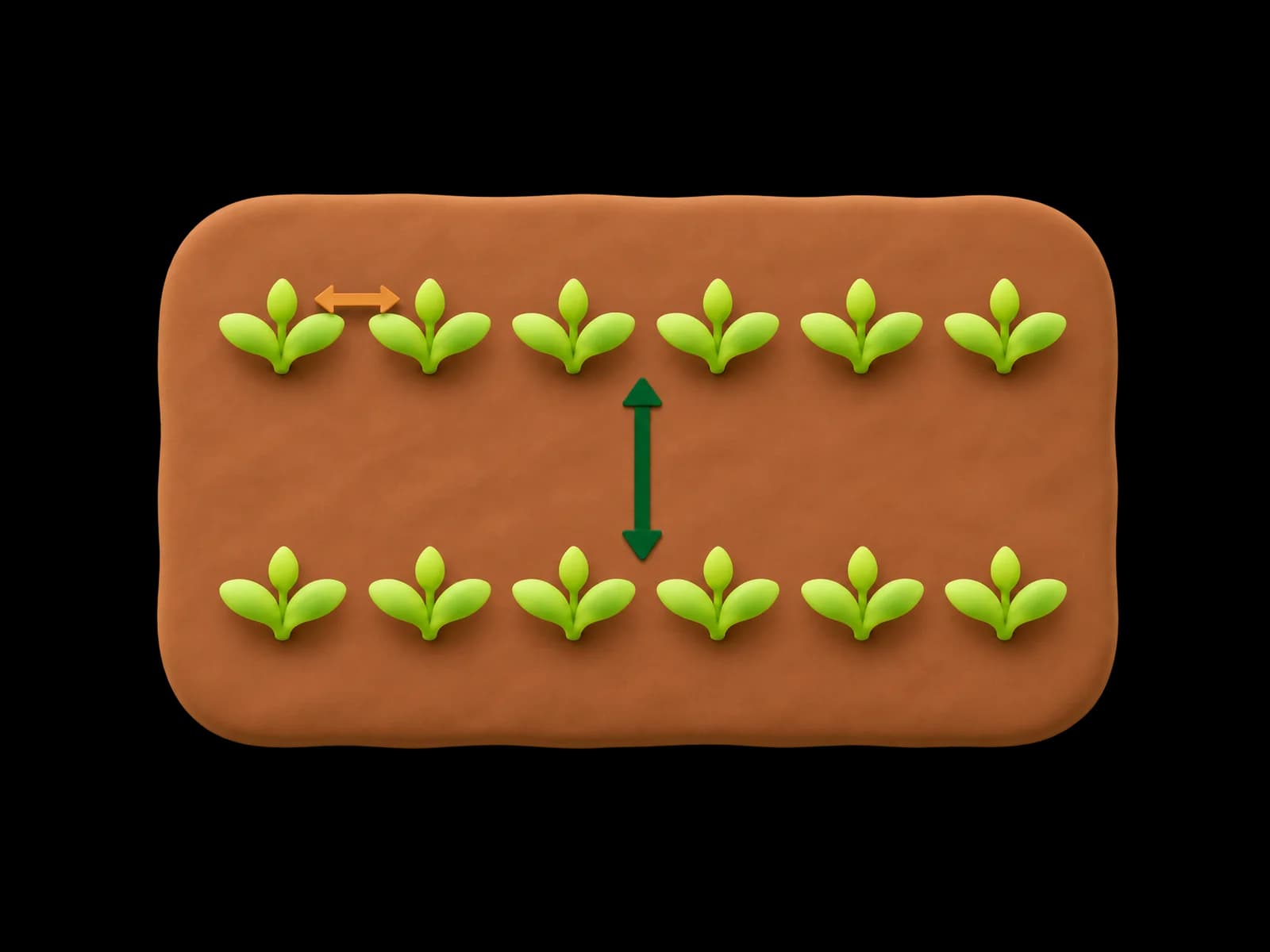
A plant spacing chart tells you two numbers for each crop: how far apart to make the rows, and how far apart to set plants within a row (or, for large crops, the square each plant needs). The chart below gives both in centimetres for 45 crops and types grown in raised beds in England, with the published range each figure comes from.
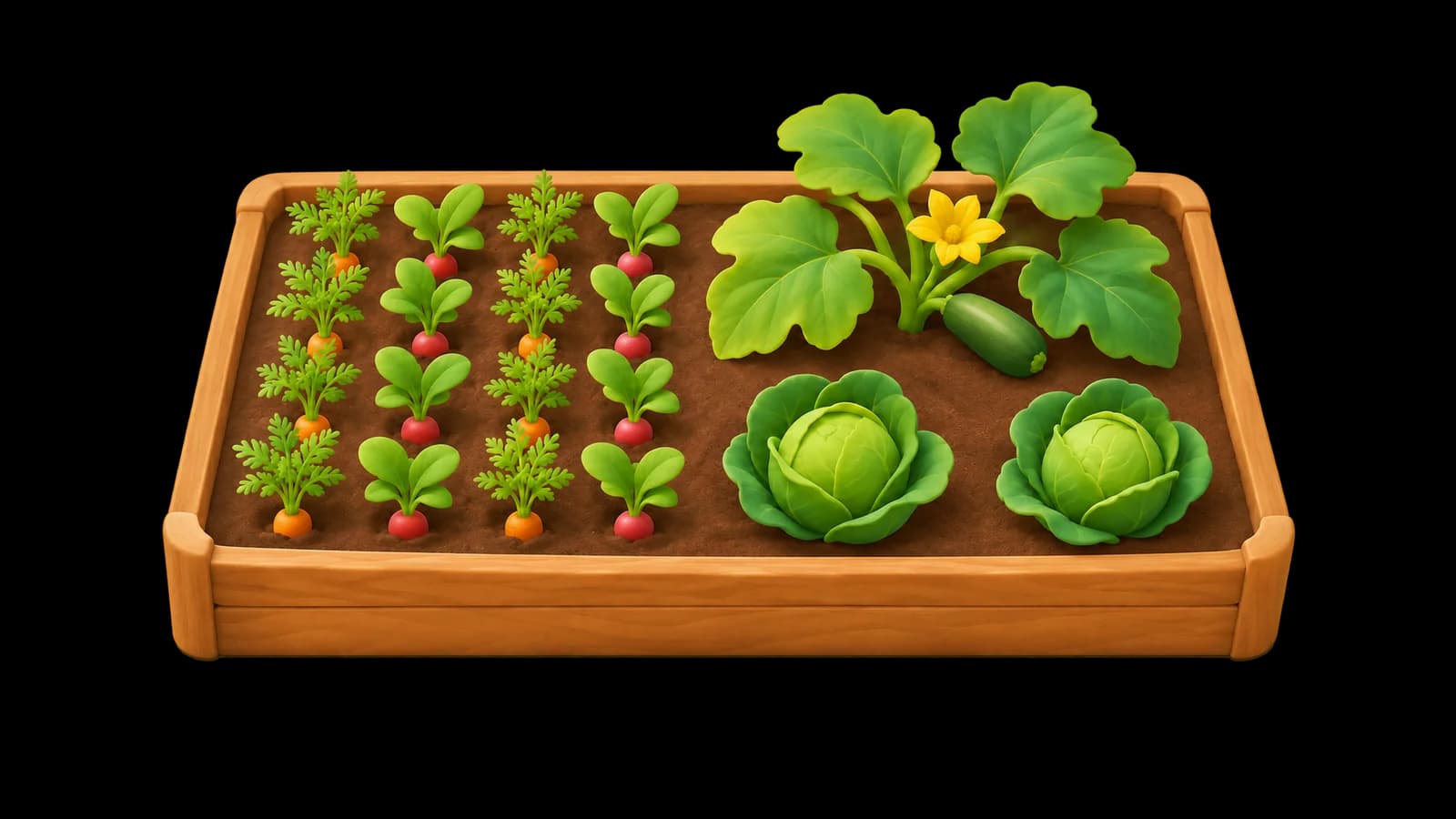
The "Sowstory spacing" column is the planning allowance the Sowstory app uses. Where sources disagree it usually takes the more generous figure, so your crops have room to reach full size. The "Published range" column shows the RHS figures behind it where the RHS gives one. Varieties differ, so if your seed packet says something different for your variety, follow the packet.
How to read the chart
- Rows apart: the distance from the centre of one row to the centre of the next.
- Plants apart: the distance between plants (or thinned seedlings) in the same row.
- Square per plant: for crops grown as single plants rather than rows, the space each one needs, for example 60 × 60 cm.
- Tall, north edge: crops that grow tall enough to shade others. Put them on the north side of the bed.
Root crops
| Crop | Sowstory spacing | Published range | Notes |
|---|---|---|---|
| Carrot (early/medium-rooted) | rows 20 cm, plants 5 cm | — | needs 30 cm of soil depth |
| Carrot (short or round-rooted) | rows 20 cm, plants 5 cm | RHS rows 15–30 cm, thin to 5–7.5 cm | suits shallower soil |
| Beetroot (round) | rows 30 cm, plants 10 cm | RHS rows 30 cm, plants 10 cm | |
| Parsnip | rows 40 cm, plants 20 cm | RHS rows 30 cm, plants 15 cm | wider supplier figure used |
| Radish (small round) | rows 15 cm, plants 2.5 cm | — | needs 20 cm of soil depth |
| Baby turnip | rows 30 cm, plants 10 cm | RHS rows 23–30 cm, plants 10 cm | |
| Kohlrabi | rows 30 cm, plants 15 cm | RHS rows 30 cm, plants 15 cm | |
| Potato, first early | rows 90 cm, plants 30 cm | — | ridge for earthing up; 30 cm soil depth |
| Potato, second early | rows 90 cm, plants 30 cm | RHS rows 60 cm, plants 30 cm | ridge for earthing up |
| Potato, maincrop | rows 90 cm, plants 37 cm | RHS rows 75 cm, plants 37 cm | ridge for earthing up |
Onions, garlic and leeks
| Crop | Sowstory spacing | Published range | Notes |
|---|---|---|---|
| Onion sets (spring-planted) | rows 25 cm, plants 10 cm | — | |
| Spring onion | rows 10 cm, plants 8 cm | — | |
| Garlic (autumn cloves) | rows 25 cm, plants 15 cm | — | |
| Leek (transplants) | rows 30 cm, plants 23 cm | RHS rows 30 cm, plants 15–20 cm | wider supplier figure used |
Leafy crops and salads
| Crop | Sowstory spacing | Published range | Notes |
|---|---|---|---|
| Lettuce, loose-leaf | rows 25 cm, plants 15 cm | — | cut-and-come-again |
| Lettuce, hearting | 30 × 30 cm per plant | — | |
| Spinach (annual) | rows 30 cm, plants 15 cm | — | |
| Chard | 30 × 45 cm per plant | — | |
| Salad rocket | rows 20 cm, plants 15 cm | RHS rows 15 cm, plants 15 cm | extra handling room |
| Pak choi (full heads) | rows 40 cm, plants 25 cm | RHS rows at least 30 cm, plants 25–30 cm | |
| Self-blanching celery | 23 × 23 cm per plant, in a block | RHS 23 cm each way | block planting shades the stems |
Peas and beans
| Crop | Sowstory spacing | Published range | Notes |
|---|---|---|---|
| Dwarf pea | rows 60 cm, seeds 7.5 cm | RHS seeds 7.5 cm apart | one broad drill per row |
| Mangetout (climbing) | one row, seeds 7.5 cm | RHS seeds 7.5 cm apart | tall, north edge, support |
| Dwarf broad bean | rows 45 cm, plants 23 cm | RHS rows 45 cm, plants 15–23 cm | |
| Dwarf French bean | rows 50 cm, plants 20 cm | RHS rows 45 cm, plants 15–23 cm | |
| Runner bean | one cane row, plants 25 cm | RHS 15–30 cm along the row | tall, north edge, support |
| Climbing French bean | one cane row, plants 25 cm | RHS canes 15 cm apart | tall, north edge, support |
Cabbage family
| Crop | Sowstory spacing | Published range | Notes |
|---|---|---|---|
| Compact summer cabbage | 45 × 45 cm per plant | RHS 30–45 cm | |
| Calabrese | 45 × 45 cm per plant | RHS rows 45 cm, plants 30–45 cm | |
| Sprouting broccoli | 60 × 60 cm per plant | RHS 60–80 cm | tall, north edge |
| Cauliflower (summer/autumn) | 60 × 60 cm per plant | RHS rows 60 cm, plants 45–60 cm | |
| Curly kale (dwarf) | 60 × 60 cm per plant | RHS 30–60 cm by variety | |
| Tall kale (e.g. cavolo nero) | 60 × 60 cm per plant | RHS 60 cm for large varieties | tall, north edge |
| Brussels sprouts | 60 × 60 cm per plant | RHS 60 cm each way | tall, north edge |
Fruiting crops
| Crop | Sowstory spacing | Published range | Notes |
|---|---|---|---|
| Tomato, outdoor cordon | 60 × 60 cm per plant | RHS 45–60 cm | tall, north edge, stake |
| Tomato, outdoor bush | 100 × 100 cm per plant | RHS 45–60 cm; some varieties spread to 1 m | north edge |
| Cucumber, outdoor (trained up) | 60 × 60 cm per plant | RHS 30 cm between sites on a wigwam | tall, north edge, support |
| Courgette (bush) | 90 × 90 cm per plant | RHS at least 90 cm | |
| Sweet pepper (outdoor) | 45 × 45 cm per plant | RHS 38–45 cm | cane each plant |
| Chilli (outdoor) | 45 × 45 cm per plant | RHS 38–45 cm |
Herbs
| Crop | Sowstory spacing | Published range | Notes |
|---|---|---|---|
| Parsley | rows 30 cm, plants 20 cm | RHS rows 20–30 cm, plants 15–30 cm | |
| Chives | 20 × 20 cm per clump | RHS 15–20 cm | perennial |
| Coriander (leaf) | 20 × 20 cm per plant | RHS 10 cm for bought plants | wider supplier figure used |
| Basil | 20 × 20 cm per plant | RHS at least 10 cm | warm, sheltered spot only |
| Dill (leaf) | rows 30 cm, plants 20 cm | RHS rows 30 cm, plants 20 cm | tall, north edge |
A dash means the published range is not recorded separately here; the Sowstory figure for those crops comes from reviewed open crop data and RHS guidance in the Sowstory knowledge base.
Using the chart to plan a bed
- Measure the inside of your bed and decide which way the rows run. Along the long edge is usually easiest; see our raised bed layout ideas.
- Place tall crops first along the north edge.
- Fill the rest with rows, adding up the row gaps until you reach the bed's width.
- Count plants per row by dividing the row length by the plant spacing. The plant spacing calculator has these counts worked out for common bed sizes.
For example, across a 1.2 m wide bed you could fit a 45 cm cane row of runner beans on the north edge, then one 30 cm row of beetroot, then two 20 cm rows of carrots: 115 cm in total.
If you would rather not add up row gaps, Sowstory uses these spacings to lay out your actual bed to scale and tells you how many plants fit. It is coming soon to the App Store, and your first bed plan is free.
Why raised bed spacing is a range, not one number
Published spacings vary because varieties vary and because growers aim for different results. A wider gap gives bigger individual plants and more airflow; a closer one gives more, smaller plants. Sowstory deliberately picks planning allowances rather than the tightest possible figures:
- Potatoes get a 90 cm row corridor in every type so there is room to earth them up into a ridge, wider than the RHS's 60 cm (earlies) and 75 cm (maincrop).
- Where sources disagree, for example parsnips (RHS 30 cm rows, a seed supplier 40 cm), the wider figure is used and the conflict recorded rather than averaged.
- Climbing beans are planned as a single cane row on the north edge, not the double A-frame rows shown in many guides, because a double row rarely suits a narrow raised bed.
For crop-by-crop detail, see how far apart to plant tomatoes, or our guides to growing carrots and growing garlic. Square-foot gardeners can compare these figures with the grid method in square foot gardening.
Sources
- RHS: How to grow beetroot
- RHS: How to grow carrots
- RHS: How to grow parsnips
- RHS: How to grow potatoes
- RHS: How to grow leeks
- RHS: How to grow peas
- RHS: How to grow runner beans
- RHS: How to grow tomatoes
- RHS: How to grow kale
- RHS: How to grow broccoli
- Sowstory knowledge base, release v1.4 (all Sowstory spacings, plus the remaining RHS and supplier ranges)