
No major UK source recommends specific potatoes companion plants: the RHS and Gardeners' World potato guides do not name any. What the evidence does support is keeping potatoes well away from tomatoes, because the two share late blight, and giving potatoes the room and rotation they need in a raised bed.
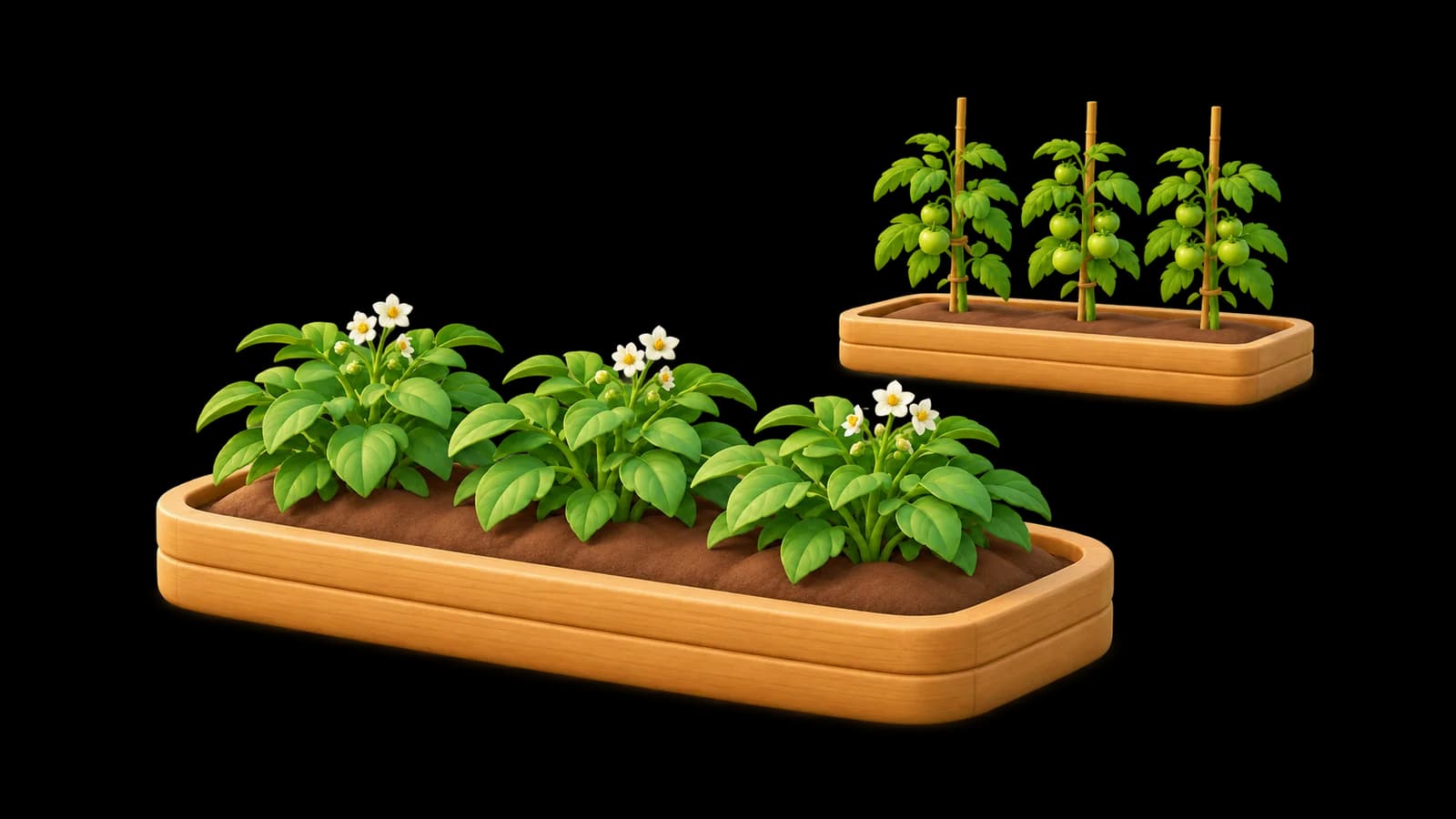
This page is honest about that gap. It explains what to keep away from potatoes and why, labels the general companion ideas you will see elsewhere as anecdotal, and suggests what can share or follow the space in a raised bed.
Potatoes companion plants: what the sources say
We looked at the RHS and Gardeners' World potato guides and both publishers' companion planting articles. Neither potato guide recommends any companion plants. The RHS companion planting article names no incompatible pairings at all.
Gardeners' World does publish a list of plants to keep apart, which includes cucumbers, squashes, radishes, sunflowers and tomatoes with potatoes. It describes that whole list as anecdotal. Only one item on it, tomatoes, has a well-established reason behind it.
| Neighbour | Keep apart? | Evidence |
|---|---|---|
| Tomatoes | Yes | Well supported: shared late blight (RHS, Gardeners' World) |
| Cucumbers, squashes, radishes, sunflowers | Listed as keep apart | Anecdotal (Gardeners' World labels the list so) |
| Any recommended companion | None named | No RHS or Gardeners' World potato guide recommends one |
Keep potatoes and tomatoes apart
Potatoes and tomatoes are closely related, and the RHS notes that they are susceptible to the same blight. Late blight is caused by Phytophthora infestans, a fungus-like organism that thrives in warm, wet weather. According to the RHS:
- UK outbreaks can start from June, earliest in the South West.
- Infection needs leaves to stay wet for a prolonged period, typically several hours.
- Most garden infection arrives as wind-blown spores.
- There are no blight fungicides available to home gardeners.
Because blight can pass between the two crops, Gardeners' World advises keeping potatoes away from tomatoes. Grow them in different beds, as far apart as your space allows, and do not plant tomatoes into last year's potato ground. Our guide to companion planting tomatoes covers the same rule from the tomato side.
Watching for blight weather
AHDB uses the Hutton Criteria, launched in 2017, as its warning system for potato late blight in Great Britain: two consecutive days, each with a minimum temperature of at least 10°C and at least six hours of relative humidity at 90% or above. The RHS points gardeners to AHDB's BlightSpy forecasting service, which tracks these periods.
If blight does appear, the RHS advises cutting off the foliage (the haulm) at soil level once about a quarter of the leaves are affected or the stems show lesions, then lifting the tubers about two weeks later.
Earth up well
Earthing up is the potato's own built-in protection. The RHS suggests drawing soil up around the stems once the shoots are about 23 cm tall, leaving the top 10 cm showing, and repeating until you have a ridge 20–30 cm high. The ridge protects young shoots from late frost and stops tubers turning green, which matters because green tubers are poisonous. The RHS adds that a good ridge gives the tubers some protection from blight spores washed down off the leaves. It is also the main reason not to plant anything in between potato rows.
Choose resistant varieties
The RHS names Athlete, Alouette, Carolus and the Sarpo range as having good blight resistance, and notes that some older choices, including Cara, Kondor, Orla, Markies and Valor, are no longer effective. First earlies, lifted early in summer, are also more likely to escape blight altogether.
General companion ideas (anecdotal)
You will see other potato companions on online charts. We found no authoritative source for any of them, so treat them as experiments rather than rules. Ideas that at least do no harm:
- Flowers at the bed ends. The RHS lists calendula among good plants for hoverflies, and around 40% of British hoverfly species have aphid-eating larvae. There is no evidence specific to potatoes.
- Nothing tucked between the rows. Potatoes are earthed up into ridges as they grow, so any plant between the rows would be buried. Sowstory reserves a 90 cm wide row for each line of potatoes to leave room for this.
What can share or follow potatoes in a raised bed
Planning the space
Potatoes take a lot of room. Sowstory plans a 90 cm wide row for each line of potatoes, wider than the RHS's 60 cm rows for earlies and 75 cm for maincrop, so there is space to earth up. In a 1.2 × 2.4 m bed, one row holds about 8 first or second early plants at 30 cm apart, or 6 maincrop plants at 37 cm. For first earlies, Sowstory checks for a bed at least 30 cm deep; see how deep a raised bed should be.
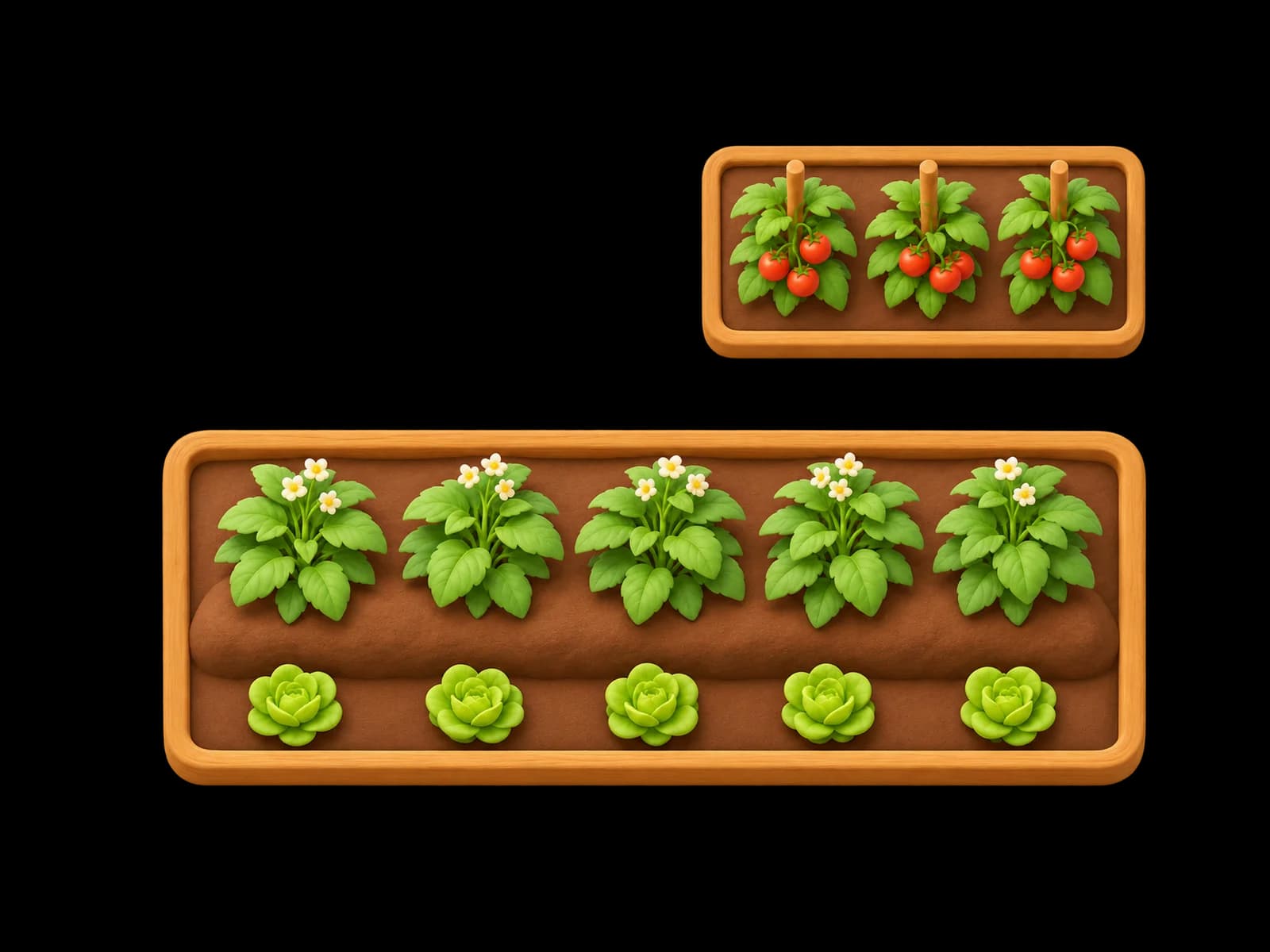
The rest of the bed's width suits low crops that will not be shaded much by the potato foliage. Check each crop in the vegetable spacing chart.
Sowstory does not score companion pairings, and it does not plan rotation across years. It does work out how many potatoes fit your bed with room to earth up, where the remaining space goes, and when each crop goes in. It is coming soon to the App Store, and your first bed plan is free.
Crops to follow early potatoes
The most useful potato "companion" is the crop that comes next. First earlies planted in March or April are lifted in June or July, and second earlies in July or August. That leaves time in the same season for quick crops. The RHS suggests lifting earlies when the flowers open or the buds drop, once the tubers are about the size of a hen's egg (scrape back a little soil to check first). Sowstory's start months allow lettuce to go in until August, and beetroot and early carrots until July. See what to sow in July for the full list.
Rotation over the years
The RHS rotation puts potatoes and tomatoes in the same family group. In its plans, legumes, onions and roots follow potatoes, and potatoes follow brassicas. It advises rotating for at least four years where blight has been a problem. Gardeners' World adds that growing potatoes in the same soil year after year builds up pests and diseases such as potato eelworm.
With only one or two raised beds, a full four-year rotation is hard to follow. The RHS says rotation suits all but very small vegetable gardens and gives no specific advice for raised beds. The simplest approach is to move potatoes to a different bed each year where you can, and to avoid putting tomatoes where potatoes grew last year.
For planting, chitting and earthing up, see our guide on how to grow potatoes. For other crops, the companion planting chart sorts popular pairings by how good the evidence is.
Sources
- RHS: How to grow potatoes
- RHS: Potato and tomato blight
- BBC Gardeners' World: How to grow potatoes
- BBC Gardeners' World: Companion planting, best plants to grow together
- BBC Gardeners' World: How to grow tomatoes
- RHS: Three ways to use companion planting
- AHDB: Hutton Criteria for potato late blight
- RHS: Hoverflies
- RHS: Crop rotation
- Sowstory knowledge base, release v1.4