
A good raised bed layout runs rows along the bed's long edge, puts tall crops such as climbing beans and cordon tomatoes on the north edge, and gives each row its own strip so the widths add up to no more than the inside width of the bed. In a 1.2 × 2.4 m (4 × 8 ft) bed that usually means three or four rows of different crops, with hardy crops sown from March and tender ones planted once frost risk has passed, which the RHS puts between May on the south coast and early June in north-east England.
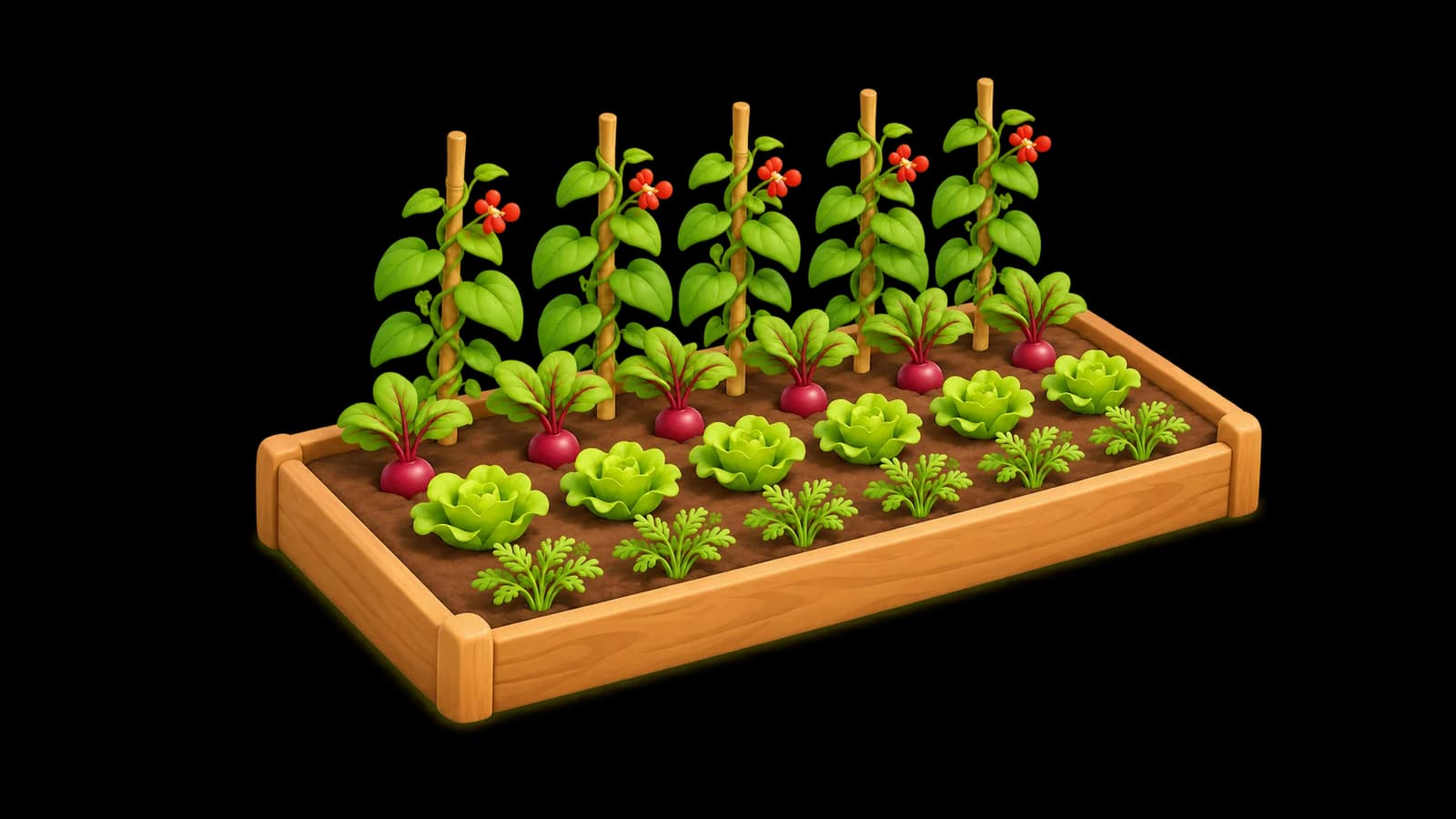
Below are six layout ideas for the three most common bed sizes. Each one is built with the spacings Sowstory uses, and each comes with a table showing the arithmetic, so you can check it or redo it for your own bed.
How to space vegetables in a raised bed
Three rules do most of the work.
- Rows run along the long edge. You get fewer, longer rows that you can reach from the sides, and each row holds one crop, which keeps sowing, thinning and weeding simple.
- Tall crops go on the north edge. This is Sowstory's planning rule, and the reason is shade. In England the midday sun is to the south, so a row of beans or tomatoes on the north side throws its shadow off the bed rather than over the lettuces and carrots. Sowstory treats climbing and runner beans, bush and cordon tomatoes, trained cucumbers, mangetout, tall kale, sprouting broccoli, Brussels sprouts and dill as tall.
- Each row gets its own strip. A row of carrots needs a 20 cm strip, a cane row of runner beans 45 cm and a row of first early potatoes 90 cm, because the soil is drawn up into a ridge around the stems. Crops grown as single plants need a square instead: 60 × 60 cm for a cordon tomato, 90 × 90 cm for a bush courgette.
The RHS's own siting advice is about the bed as a whole: choose a sunny spot, keep beds narrower than 1.5 m so you can reach the middle without treading on the soil, and run long beds north to south for even light. In a bed that runs north to south, the north edge is a short end, so tall crops go in a short row or block at that end. The plans below assume one long side faces north. The vegetable spacing chart lists the row and plant gaps for every crop.
How the plans are worked out
Every plan passes two checks.
- Widths across the bed. Add up the strip each row needs. The total must be no more than the inside width.
- Plants along each row. Divide the row length by the in-row spacing and round down. A 240 cm row of beetroot at 10 cm apart gives 240 ÷ 10 = 24 plants.
These are hand counts with no allowance for the frame. Measure inside the timber, and expect an app plan, which keeps plants a little clear of the edges, to show slightly fewer. The plant spacing calculator explains the formulas in more detail.
4 × 8 raised bed layout (1.2 × 2.4 m)
The most common bed size gives you an inside width of 120 cm and rows 240 cm long.
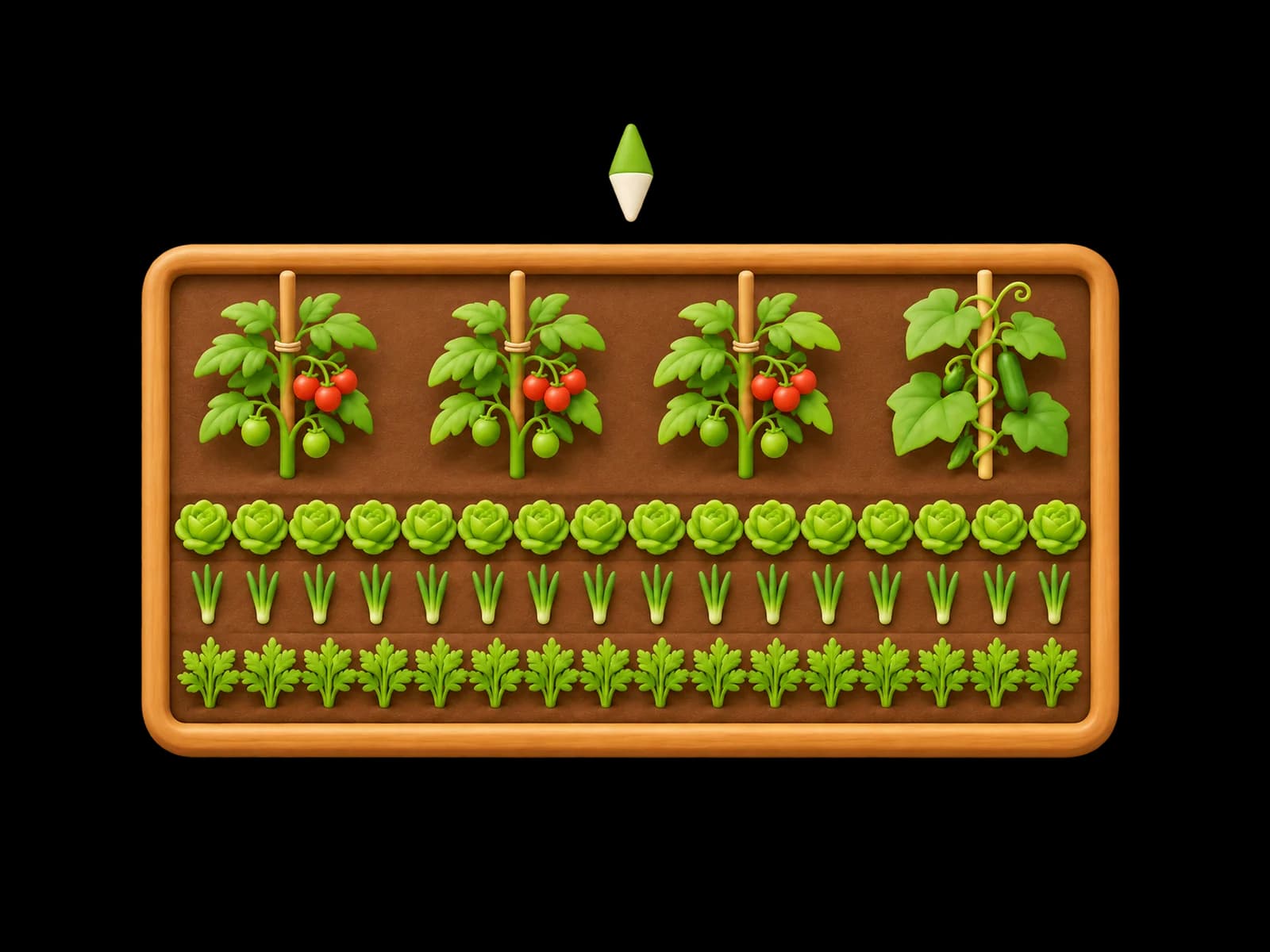
Plan 1: summer tomatoes and salads (full sun)
| Row, north to south | Crop | Strip width | In-row spacing | Plants per row |
|---|---|---|---|---|
| 1, north edge | Cordon tomatoes (3) and one trained outdoor cucumber | 60 cm | 60 cm | 240 ÷ 60 = 4 |
| 2 | Loose-leaf lettuce | 25 cm | 15 cm | 240 ÷ 15 = 16 |
| 3 | Spring onions | 10 cm | 8 cm | 240 ÷ 8 = 30 |
| 4 | Carrots | 20 cm | 5 cm | 240 ÷ 5 = 48 |
| Total | 115 cm of 120 cm |
The tomatoes and cucumber are tender, so Sowstory starts them in June. Each cordon tomato needs a tall stake and the cucumber needs a cane or netting to climb. Lettuce, spring onions and carrots can be sown from March and resown as rows are cleared. Sowstory plans no more than three outdoor cordon tomatoes in one bed; tomato spacing explains why they need so much room. This bed needs full sun: tomatoes and cucumbers want at least six hours a day.
Plan 2: an easy direct-sown bed (full sun)
| Row, north to south | Crop | Strip width | In-row spacing | Plants per row |
|---|---|---|---|---|
| 1, north edge | Runner beans on one cane row | 45 cm | 25 cm | 240 ÷ 25 = 9.6, so 9 |
| 2 | Beetroot | 30 cm | 10 cm | 240 ÷ 10 = 24 |
| 3 | Loose-leaf lettuce | 25 cm | 15 cm | 240 ÷ 15 = 16 |
| 4 | Radishes | 15 cm | 2.5 cm | 240 ÷ 2.5 = 96 |
| Total | 115 cm of 120 cm |
Everything here can be sown straight into the bed. Radishes and lettuce go in from March and beetroot from April. Runner beans are sown outdoors from mid-May to July once the soil is warm, or raised indoors and planted out after frost. Sowstory reserves a radish row for only about eight weeks, so you can sow it several times in one summer.
Prefer potatoes? One row of first earlies takes a 90 cm strip and fits 240 ÷ 30 = 8 tubers, which leaves room for one 20 cm row of carrots (110 cm in total).
3 × 6 raised bed layout (0.9 × 1.8 m)
This smaller bed gives you an inside width of 90 cm and rows 180 cm long.
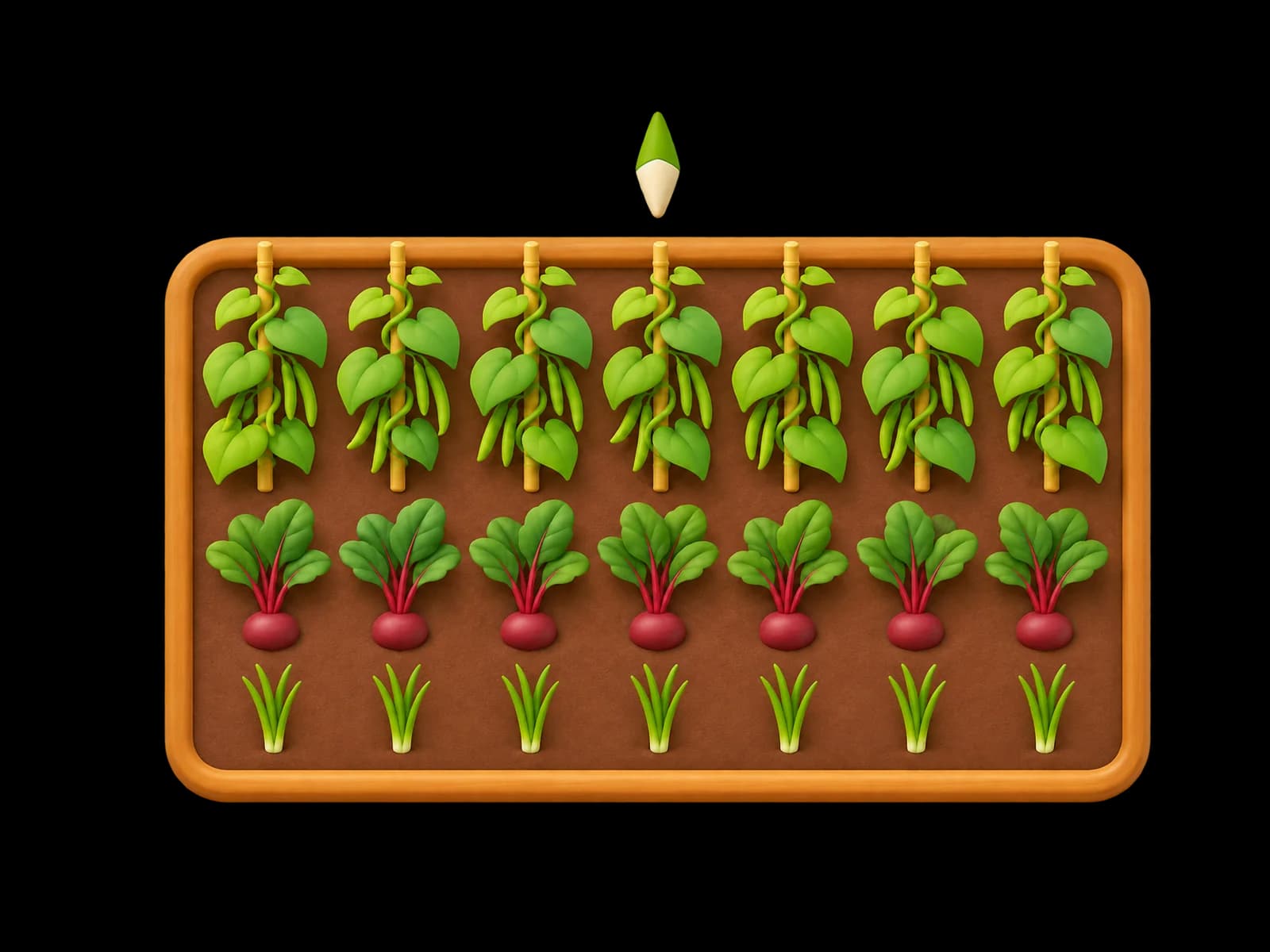
Plan 3: climbing beans with roots
| Row, north to south | Crop | Strip width | In-row spacing | Plants per row |
|---|---|---|---|---|
| 1, north edge | Climbing French beans on one cane row | 45 cm | 25 cm | 180 ÷ 25 = 7.2, so 7 |
| 2 | Beetroot | 30 cm | 10 cm | 180 ÷ 10 = 18 |
| 3 | Spring onions | 10 cm | 8 cm | 180 ÷ 8 = 22.5, so 22 |
| Total | 85 cm of 90 cm |
Climbing French beans start in the bed in May or June, after frost, and crop from July to October. Beetroot and spring onions can be sown from April, and the spring onions resown through the summer.
Plan 4: a part-shade salad and herb bed (4–6 hours of sun)
| Row, north to south | Crop | Strip width | In-row spacing | Plants per row |
|---|---|---|---|---|
| 1, north edge | Parsley | 30 cm | 20 cm | 180 ÷ 20 = 9 |
| 2 | Annual spinach | 30 cm | 15 cm | 180 ÷ 15 = 12 |
| 3 | Loose-leaf lettuce | 25 cm | 15 cm | 180 ÷ 15 = 12 |
| Total | 85 cm of 90 cm |
None of these crops is tall. Parsley goes at the back because it stays longest (Sowstory reserves its row for about six months), so the spinach and lettuce rows in front can be cleared and resown. All three tolerate 4–6 hours of sun in Sowstory's plans, and the RHS lists spinach, lettuce and leaf salads among crops fairly tolerant of light shade. Spinach is a cool-season crop: Sowstory starts it from March to May and again in August and September.
4 × 4 raised bed layout (1.2 × 1.2 m)
A square bed has no long edge, so pick the side that faces north for anything tall. Width and row length are both 120 cm.
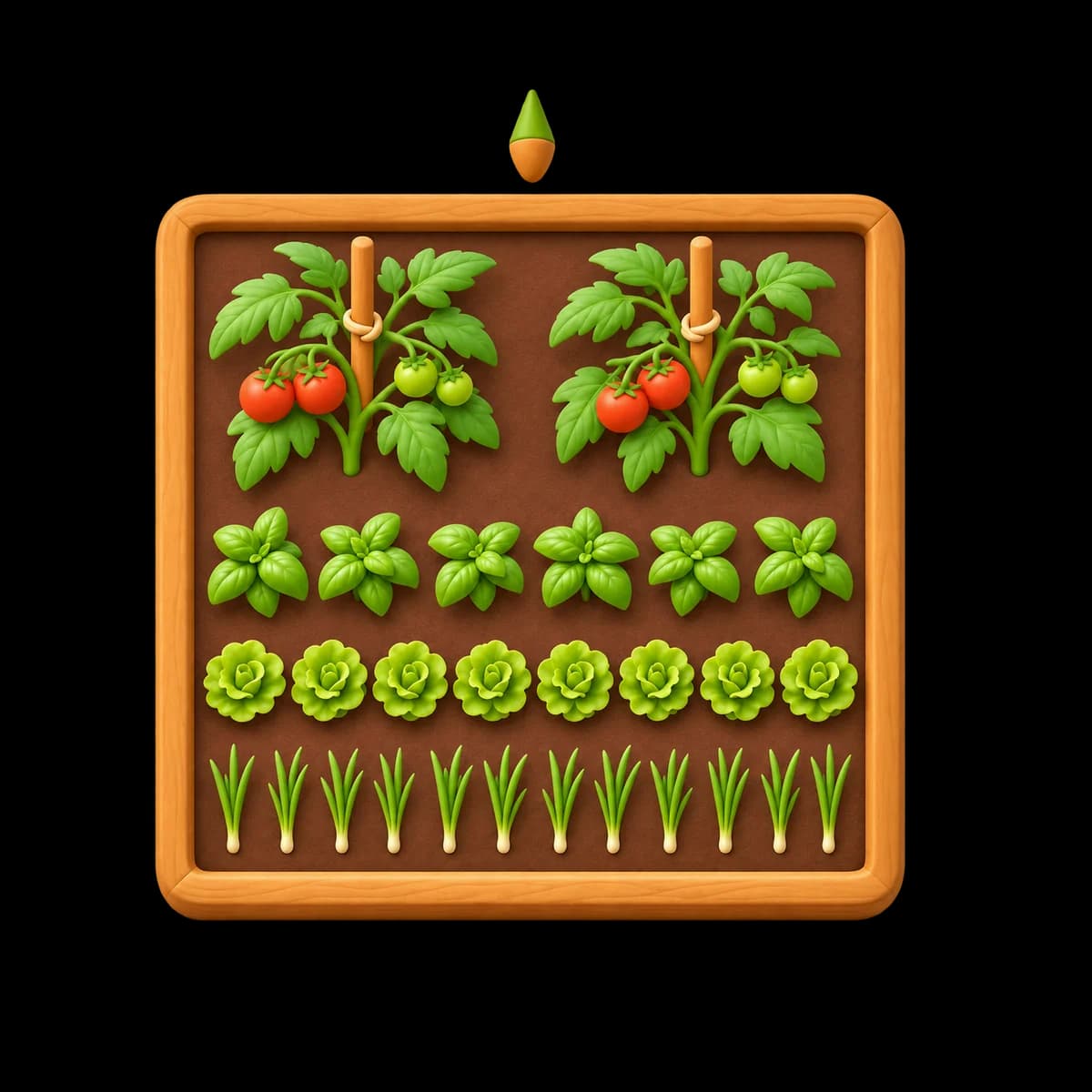
Plan 5: two tomatoes, basil and salad
| Row, north to south | Crop | Strip width | In-row spacing | Plants per row |
|---|---|---|---|---|
| 1, north edge | Cordon tomatoes | 60 cm | 60 cm | 120 ÷ 60 = 2 |
| 2 | Basil | 20 cm | 20 cm | 120 ÷ 20 = 6 |
| 3 | Loose-leaf lettuce | 25 cm | 15 cm | 120 ÷ 15 = 8 |
| 4 | Spring onions | 10 cm | 8 cm | 120 ÷ 8 = 15 |
| Total | 115 cm of 120 cm |
Basil is the riskiest crop here. The RHS advises growing it outdoors only in a warm, sunny, sheltered spot, so Sowstory starts it in June once nights stay above 10°C, and treats it as low confidence.
Plan 6: autumn garlic with spinach
| Row, north to south | Crop | Strip width | In-row spacing | Plants per row |
|---|---|---|---|---|
| 1 | Garlic | 25 cm | 15 cm | 120 ÷ 15 = 8 |
| 2 | Garlic | 25 cm | 15 cm | 120 ÷ 15 = 8 |
| 3 | Garlic | 25 cm | 15 cm | 120 ÷ 15 = 8 |
| 4 | Annual spinach | 30 cm | 15 cm | 120 ÷ 15 = 8 |
| Total | 105 cm of 120 cm |
Sow the spinach in September and plant the 24 garlic cloves between October and December. Sowstory plans no more than three rows of garlic per bed and holds the space for about 36 weeks, into the following summer, so this is mainly a garlic bed until you lift it. Our guide on how to grow garlic covers planting depth and timing.
One warning for small beds: a bush courgette needs about 90 × 90 cm, so a single plant leaves only a 30 cm strip along two sides of a 4 × 4 bed.
Keeping the layout productive all season
- Resow the quick rows. Sowstory reserves space for about 56 days for radishes, 70 days for loose-leaf lettuce and spring onions, and 84 days for carrots. When a row is cleared, sow it again or follow it with another crop.
- Place long-stay crops with care. Garlic, parsnips, leeks and winter kale hold their space for about eight months or longer, so give them rows you will not need for summer resowing.
- Wait for frost to pass before tender crops. The RHS gives typical safe planting-out times from the first half of May on the south-west tip and south coast to early June in north-east England, with sheltered, urban or coastal gardens 1–2 weeks earlier and exposed or high sites 1–3 weeks later. Our last frost date guide explains how to judge it.
- Check the depth. Sowstory checks for at least 30 cm of soil for early carrots and first early potatoes, and 20 cm for radishes. See how deep a raised bed should be and raised bed soil for what to fill it with.
If you would rather not add up strips and divide row lengths by hand, Sowstory will lay out your bed to scale with tall crops on the north edge, tell you how many plants or rows fit, and give you a month-by-month plan. It is coming soon to the App Store, and your first bed plan is free.
Common raised bed layout mistakes
- Using one spacing for both directions. Carrots can sit 5 cm apart in the row but need 20 cm between rows. Use both numbers.
- Squeezing in one more row. If the strips add up to more than the inside width, crops will crowd each other. Drop a row rather than narrowing every gap.
- Tall crops on the south side. Beans or tomatoes on the sunny side shade everything behind them for much of the day.
- Forgetting the paths. The RHS suggests paths at least 45 cm wide between beds so a wheelbarrow fits. Our guide to vegetable garden layout covers planning several beds, and raised bed sizes helps if you are still choosing a frame.
Not sure which crops to put in your rows? Start with our list of what to grow in a raised bed, or compare these row layouts with the grid approach in square foot gardening.
Sources
- RHS: How to make a raised bed
- RHS: When to plant out tender plants
- RHS: Shade gardening
- RHS: How to grow basil
- Sowstory knowledge base, release v1.4