
For companion planting tomatoes, the best-evidenced partner is the French marigold: glasshouse trials found its scent repels whitefly. Basil, nasturtiums and calendula are popular tomato companions too, but the evidence for them is mostly anecdotal, and the one neighbour you have a clear reason to avoid is the potato, because both crops catch the same blight.
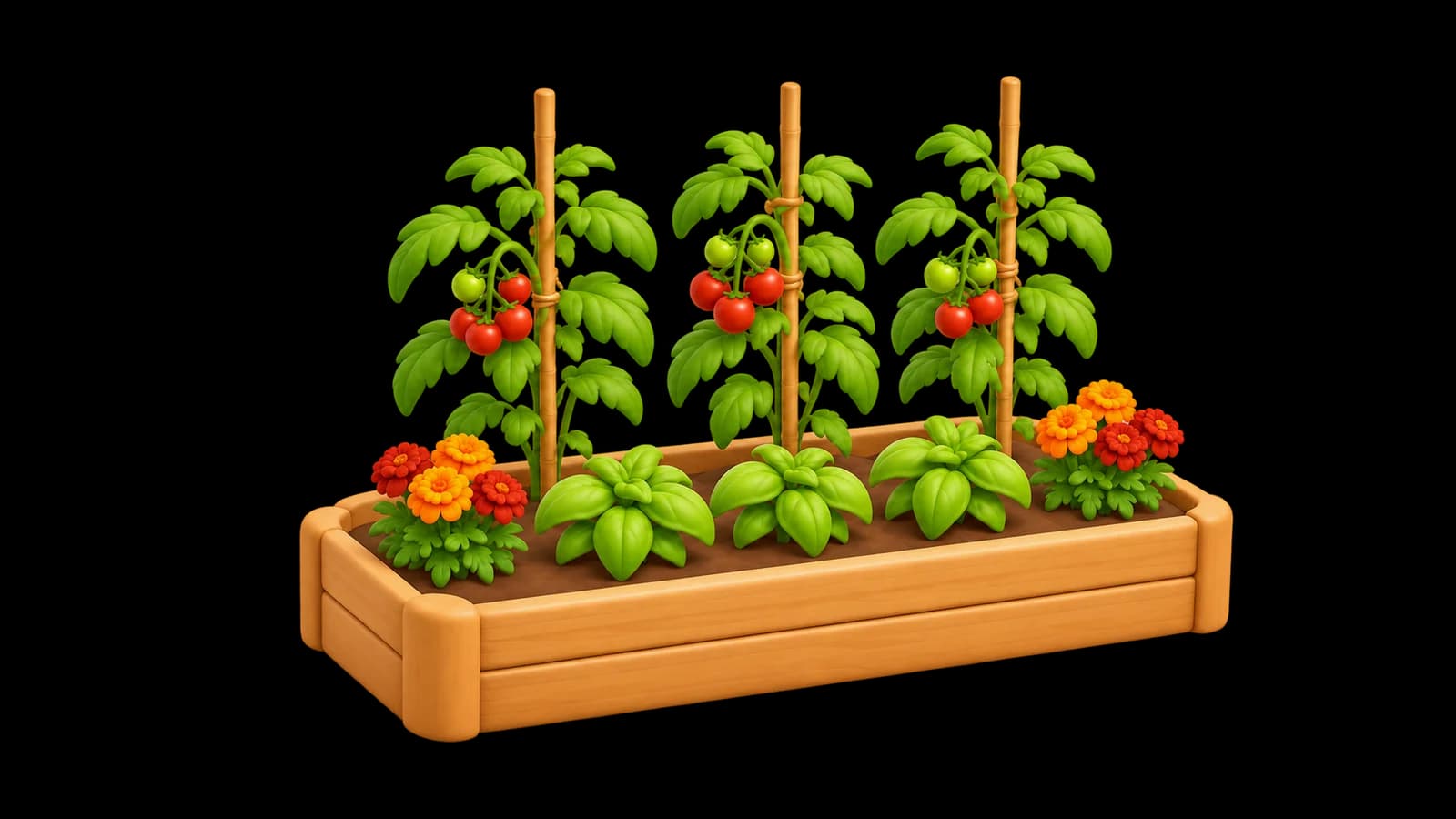
This guide sorts tomato companions by how good the evidence is, explains what not to plant with tomatoes and why, and shows a simple way to arrange them in a raised bed in England.
Companion planting tomatoes: how good is the evidence?
Companion planting means growing plants together so that each benefits. The RHS groups the claimed benefits into three: using space well, deterring pests and diseases, and plants supporting each other. It thinks the benefits probably exist, but not for every crop in every situation, and leaves trying it to personal choice.
Gardeners' World is blunter: it describes the evidence for companion planting as largely anecdotal, while saying many combinations make good sense. So it helps to know which tomato pairings have been tested and which are tradition.
| Plant | Claimed benefit for tomatoes | Evidence |
|---|---|---|
| French marigold | Scent repels whitefly | Trial-backed (glasshouse trials) |
| Basil and other herbs | May confuse pests; catch crop | Anecdotal |
| Calendula and nasturtium | Attract helpful insects | Hoped for, not shown (RHS) |
| Potato | Keep apart: shared late blight | Well supported |
| Brassicas | Keep apart | Anecdotal only |
| Fennel | Often listed as harmful | No authoritative source found |
Tomatoes companion plants worth growing
French marigolds (the best-evidenced choice)
French marigolds (Tagetes) are the one tomato companion with research behind them. Two large glasshouse trials at Newcastle University, published in 2019, found that French marigolds repelled tomato whitefly, and identified limonene, the same chemical found in citrus peel, as the main active compound. The whitefly were deterred and slowed, not killed.
The RHS summarises the same work and adds that mixing tomatoes with other plants, without marigolds, gave a similar effect. Two caveats are worth knowing. The trials were in glasshouses, not outdoor beds, and whitefly is mainly a problem under glass. Gardeners' World suggests French marigolds about 10 cm apart among greenhouse tomatoes. Outdoors they still add colour and flowers, and they take little room at the ends of a tomato row.
Planting basil with tomatoes
Basil is the classic partner on the plate and in the bed. Gardeners' World suggests growing basil and other herbs at the base of tomatoes as a catch crop that may confuse pests, but gives no trial evidence, and the RHS basil guide does not mention tomatoes at all.
The better reason to plant them together is that they want the same conditions. Both are tender, both need warmth, and Sowstory gives both a full-sun rule of at least six hours of direct sun. Basil is short (the RHS gives 20–50 cm), so it sits happily in front of staked tomatoes without shading them. Be honest with yourself about your site, though: the RHS says basil only does well outdoors in a warm, sunny, sheltered spot. Our basil growing guide covers when it is safe to plant out.
Calendula, nasturtiums and other flowers
Flowers rich in nectar and pollen draw in beneficial insects. Around 40% of British hoverfly species have larvae that eat aphids, according to the RHS, and English marigold (Calendula) is on its list of good hoverfly plants. The RHS is careful, though: it says calendula and nasturtiums are planted near tomatoes "in the hope of" a similar pest-control effect, not because it has been shown.
If you have the space, a few of these flowers at the bed ends do no harm. Just keep them from crowding the tomatoes.
Quick crops in the gaps
The space-saving side of companion planting is the most practical. The RHS describes growing fast crops such as lettuce and radish between slower ones, then clearing them before they are shaded. Young outdoor tomatoes go into the bed in June and take weeks to fill out, so a row of quick salad on their south side can be picked before the tomatoes close over it.
What not to plant with tomatoes
Potatoes: the one with a clear reason
This is the bad-neighbour rule with solid support. The RHS notes that tomatoes are closely related to potatoes and are susceptible to the same blight outdoors. Late blight is caused by Phytophthora infestans, a fungus-like organism that thrives in warm, wet weather. In the UK, outbreaks can start from June, earliest in the South West, and most garden infections arrive as wind-blown spores.
Gardeners' World advises keeping potatoes away from tomatoes because one can pass infection to the other. There are no blight fungicides available to home gardeners, so distance, rotation and resistant varieties are what you have. Our potato companion guide covers the same rule from the potato side.
Anything that shades or crowds them
Gardeners' World points out that the more practical bad-neighbour problems are tall plants shading short ones, and thirsty plants competing with each other. For tomatoes, that means avoiding tall or vigorous plants that would shade them or compete for water. Tomatoes need full sun, so put them where nothing taller stands to their south.
Brassicas and fennel: weak or no evidence
"Brassicas with tomatoes" appears on Gardeners' World's list of plants to keep apart, but the magazine itself labels the whole list anecdotal. Fennel turns up on many online charts as harmful to tomatoes. We could not find any authoritative source that says so, so we do not repeat it as a rule. If you want to grow fennel, the reason to keep it away from tomatoes is the same as for anything tall: shade.
How to lay out tomatoes and companions in a raised bed
A layout that follows the evidence and the light looks like this, for a bed with its long side running east to west:
- North edge: cordon tomatoes on tall canes. Sowstory allows a 60 × 60 cm square for each one and plans up to three in a 1.2 × 2.4 m bed. Full spacing detail is in our tomato spacing guide.
- In front of the tomatoes: basil, which Sowstory spaces at about 20 cm.
- Row ends: a few French marigolds.
- South side: low crops, such as lettuce or carrots, that will not shade anything.
- Elsewhere: potatoes, in a different bed.
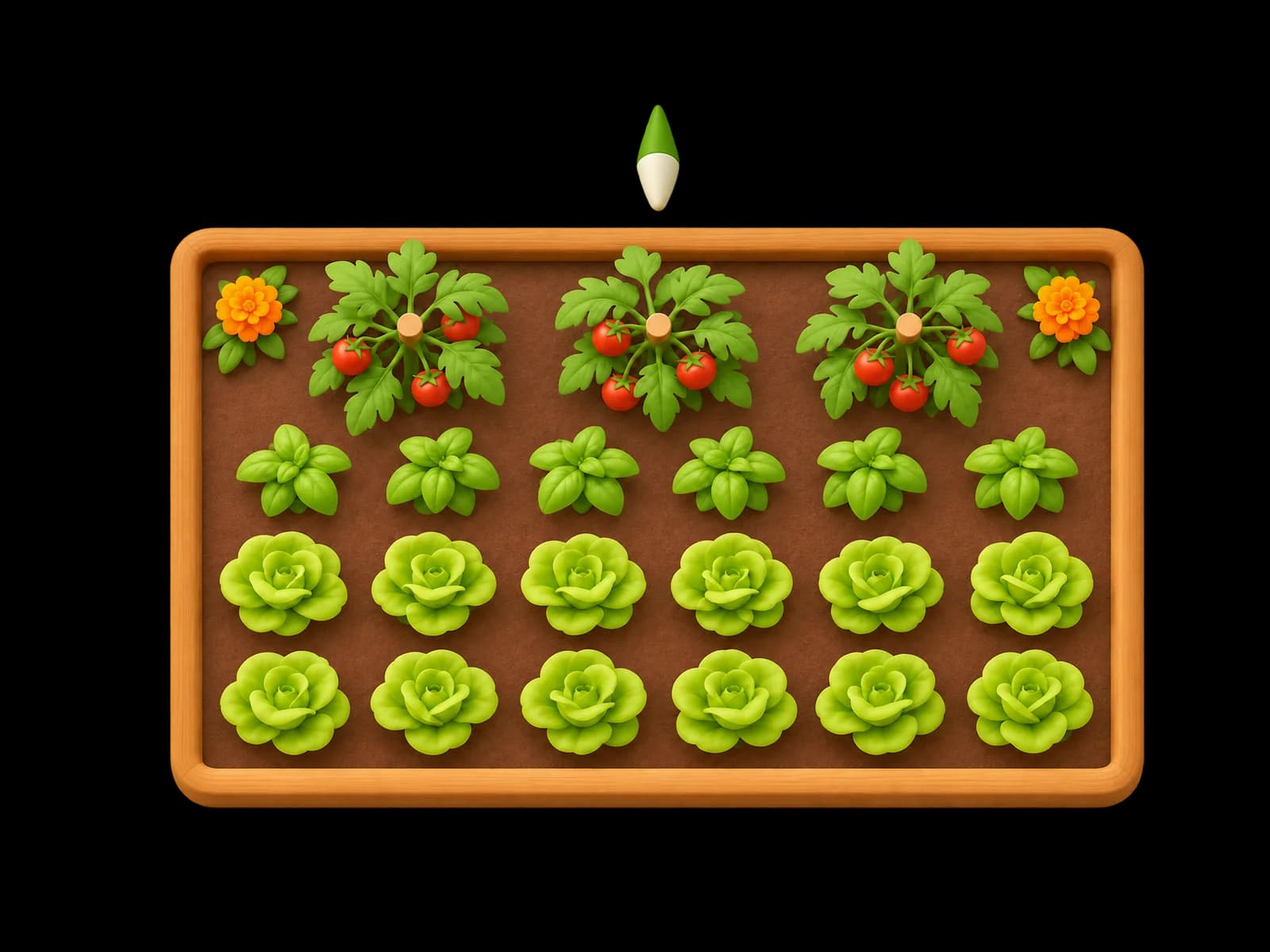
Putting tomatoes on the north edge is the neighbour rule that matters most in a small bed. Staked cordons grow tall, and on the north side their shadow falls off the bed instead of across your other crops. For more arrangements, see our raised bed layout ideas.
Sowstory does not score companion pairings; it does place tall crops such as tomatoes on the north edge automatically and works out how many plants fit alongside everything else. If you would like that layout drawn to scale for your own bed, Sowstory is coming soon to the App Store, and your first bed plan is free.
Rotate: keep tomatoes off last year's potato ground
The RHS puts tomatoes and potatoes in the same rotation group, and advises against growing tomatoes in the same bed in consecutive years. After a blight outbreak, it suggests not growing tomatoes in soil used for potatoes during a four-year rotation. With only one or two beds, that can be hard, but even swapping ends of the bed helps you avoid planting straight back into last year's potato ground.
Tomatoes go into the bed outdoors in June in Sowstory's plan, once nights stay warm, so plan companions to suit. See what to sow in June for what else goes in that month, and our tomato growing guide for sowing, side-shooting and feeding. The full companion planting chart covers other vegetables.
Sources
- RHS: Three ways to use companion planting
- Newcastle University: marigolds, whitefly and limonene (2019)
- BBC Gardeners' World: Companion planting combinations
- BBC Gardeners' World: Companion planting, best plants to grow together
- BBC Gardeners' World: How to grow tomatoes
- RHS: How to grow tomatoes
- RHS: Potato and tomato blight
- RHS: Hoverflies
- RHS: How to grow basil
- Sowstory knowledge base, release v1.4