
To grow carrots in England, sow the seed thinly and directly into a fine, stone-free bed between March and July, in drills about 1 cm deep and 20 cm apart, and cover the crop with insect mesh against carrot fly. The RHS says most carrots are ready 12 to 16 weeks after sowing.
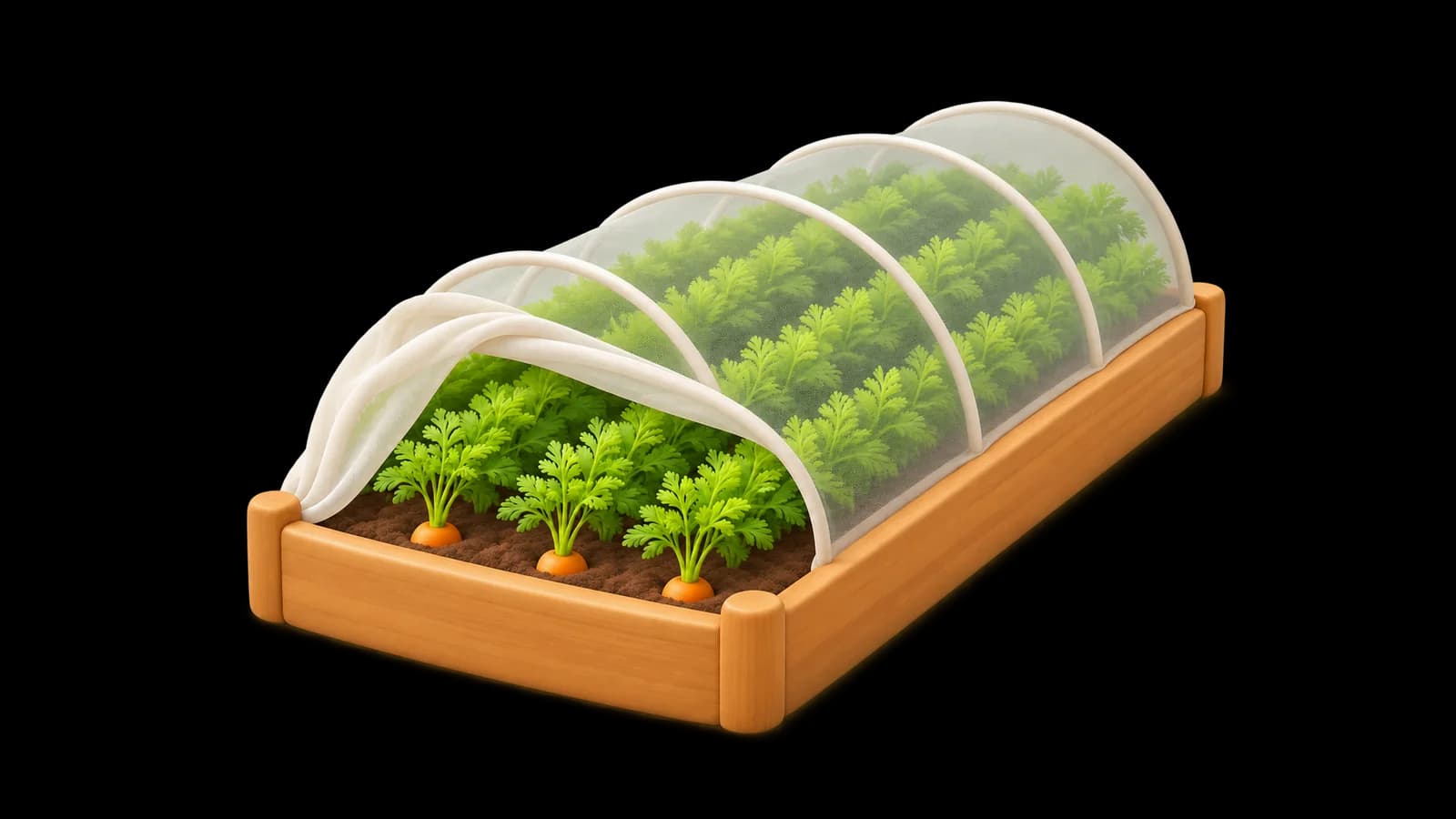
A raised bed filled with fine, stone-free soil suits carrots, because stones and heavy clay make long roots fork. This guide covers when to sow, early and short-rooted types, spacing, how many fit a bed, carrot fly and harvest.
Carrot quick facts
| Fact | Detail |
|---|---|
| Sow direct | Early carrots March to July; short-rooted April to July (Sowstory). RHS: April to early July outdoors |
| Sowing depth | About 1 cm (RHS); 1.5 cm for Paris Market (Mr Fothergill's) |
| Spacing | Rows 20 cm apart, carrots 5 cm apart (RHS: rows 15–30 cm, thin to 5–7.5 cm) |
| Sun | At least six hours of direct sun |
| Time to harvest | 12–16 weeks (RHS); Sowstory reserves 12 weeks |
| Bed depth | Sowstory checks at least 30 cm for early carrots |
| In a 1.2 × 2.4 m bed | About 192 carrots in four rows |
When to sow carrots in the UK
Carrots are sown where they will grow; the RHS warns that transplanting causes forked roots. The RHS gives April to early July for outdoor sowing, with early varieties possible under cloches in February and March. Sowstory's window for England is March to July for early carrots and April to July for short-rooted types.
Within that window, three things shift the date:
- Your area. The south and coasts can usually start earlier than the north, inland areas and high ground. Sowstory's months are England-wide, so judge the soil on the day: cold, wet soil in March is a reason to wait.
- Carrot fly. The RHS says sowing after mid-May avoids the first generation of the pest. Gardeners' World says sowings from June are less prone.
- A steady supply. The RHS suggests a fresh sowing every three to four weeks rather than one big row.
For month-by-month lists, see what to sow in March, April, May, June and July.
Early carrots or short-rooted carrots?
Sowstory plans two kinds of carrot:
- Early (medium-rooted) carrots, sown March to July. These are the classic tapering carrot, so Sowstory checks the bed has at least 30 cm of soil before it plans them.
- Short-rooted (round) carrots, such as the Paris Market type, sown April to July and harvested from June to October. The RHS says short and round types cope better with shallow, stony or heavy clay soil and suit pots. Sowstory sets no minimum depth for them.
If your bed is shallow, short-rooted carrots are the safer choice. Our guide to how deep a raised bed should be compares the depth needs of different crops.
How to sow carrots
Prepare the soil
Long roots fork or twist when they hit stones, lumps or heavy clay, and overcrowding distorts them too. Rake the surface fine and pick out stones. Gardeners' World adds that very rich soil can also cause forking, so add organic matter the year before you grow carrots rather than just before sowing.
Sow thinly in shallow drills
Make drills about 1 cm deep (the RHS figure; Mr Fothergill's gives 1.5 cm for Paris Market) and 20 cm apart. Sow as thinly as you can. The RHS explains why this matters: female carrot flies are drawn by the scent released when seedlings are thinned, so the less thinning you do, the better.
Thin to the final spacing
Thin to about 5 cm between plants. The RHS range is 5–7.5 cm; Sowstory plans on the closer 5 cm. With round varieties, Mr Fothergill's suggests pulling young roots evenly along the row to eat as you go, rather than thinning to a set gap.
Growing carrots in raised beds: how many fit
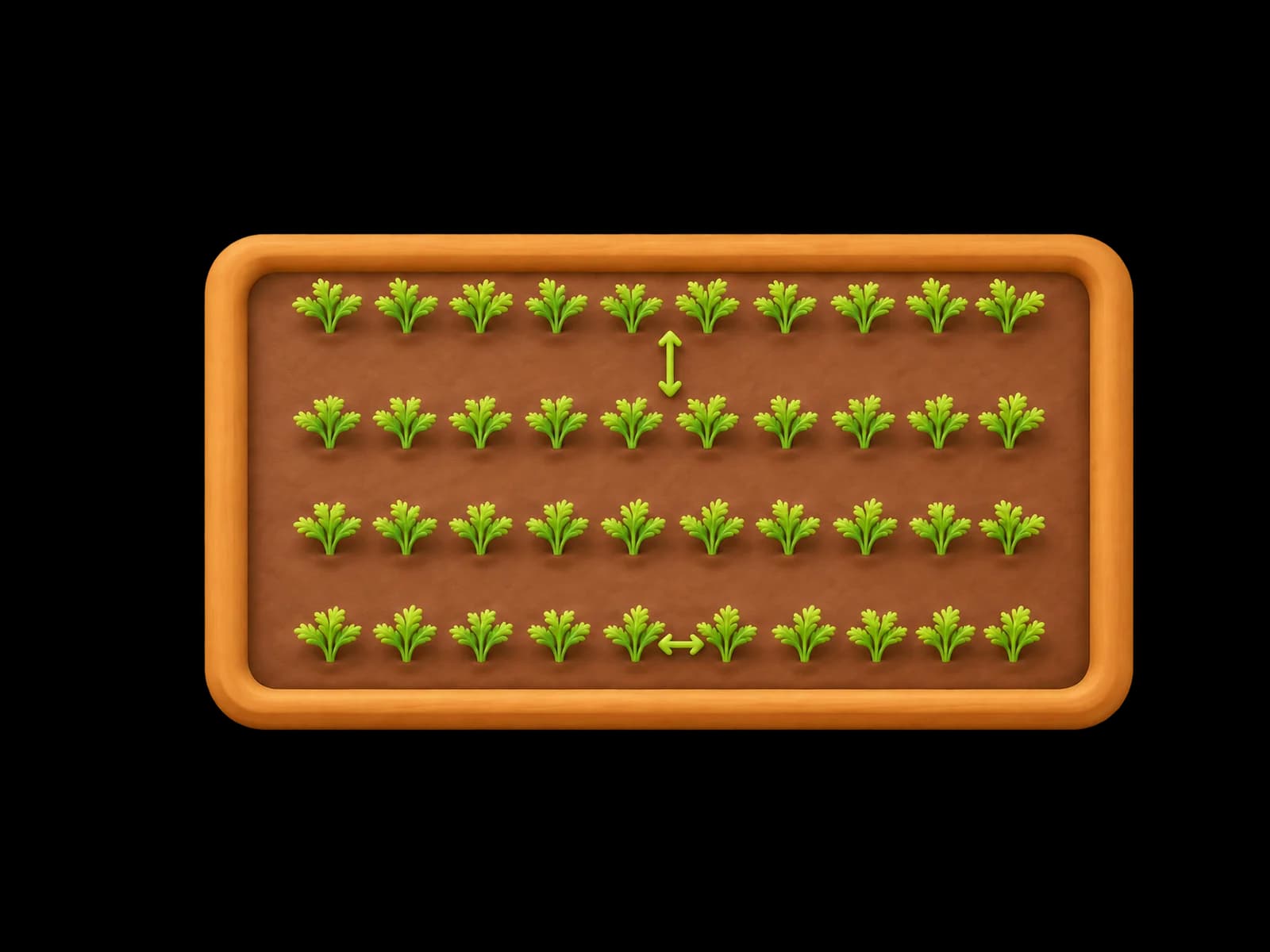
With Sowstory's spacing (rows 20 cm apart, carrots 5 cm apart), a 1.2 × 2.4 m bed (about 4 × 8 ft) holds four rows of about 48 carrots: about 192 carrots if you gave the whole bed to them. Sowstory plans no more than four rows of carrots per bed, whether early or short-rooted. A single metre of row gives about 20 carrots.
Carrots are low-growing and can go on the sunny south side of the bed, away from tall crops on the north edge. The vegetable spacing chart and raised bed layout guide show how they fit alongside other crops. Because each sowing occupies its row for about 12 weeks, an early row can be followed by another crop later in the season.
If you would rather not work out the rows by hand, Sowstory lays out your bed to scale, checks the depth for early carrots, tells you how many rows fit and gives a month-by-month plan for England. It is coming soon to the App Store, and your first bed plan is free.
Carrot fly: how to keep it out
Carrot fly (Psila rosae) is the main pest. Its larvae tunnel into the roots. The RHS says it also attacks parsnips, parsley, celery and celeriac, lays eggs from late May to June and again in August to September, and spends the winter in the soil.
What works, according to the sources:
- Insect mesh. RHS research found a complete cover of insect-proof netting more effective than a barrier. Standard insect mesh of 1.3–1.4 mm is fine enough. Keep rotating even under mesh, because flies can emerge inside from pupae left in the soil.
- Timing. Sow after mid-May to miss the first generation, and harvest before late August to miss the second.
- Less susceptible varieties. The RHS names 'Fly Away', 'Maestro', 'Resistafly' and 'Sytan'. They are not immune: AHDB says even the most resistant carry roughly half the damage of a very susceptible variety, so use them alongside other measures.
- Sowing thinly, so there is little thinning to release scent.
Barriers are less certain. Gardeners' World recommends a 60 cm barrier in one guide and at least 45 cm of fine mesh in another; AHDB trials found fences up to 2 m high reduced but did not stop carrot fly. The RHS describes the adult as a weak flier but does not give a safe height.
Growing onions or garlic beside carrots to mask their scent is a popular idea. Gardeners' World says alliums may help but gives no trial evidence, and the RHS does not recommend it as a control. See companion planting for what the evidence supports, and how to grow onions if you want them in the same bed anyway.
Harvesting carrots
The RHS says carrots are ready 12 to 16 weeks after sowing. Pull a test root first. Round types harvested young can be pulled as they reach a useful size, and Mr Fothergill's gives June to October for Paris Market. If you are avoiding the second carrot fly generation, aim to lift before late August.
Common carrot problems
- Forked or twisted roots: stones, compacted or heavy soil, very rich soil, crowding, or transplanting.
- Tunnels in the roots: carrot fly larvae; use mesh next time and move the crop.
- Poor roots in shallow beds: switch to short-rooted varieties.
What Sowstory's carrot plan does and does not cover
- Outdoor sowings only. Sowstory plans carrots sown direct into the open bed. It does not plan the RHS's earlier sowings under cloches in February and March, so its first month is March for early carrots and April for short-rooted ones.
- England-wide months. The sowing window is the same across England; it is not adjusted for your postcode or local climate. Check that the soil has warmed and dried a little before an early sowing.
- Planning spacing. The 20 cm rows and 5 cm gaps are planning allowances taken from published guidance. Varieties differ, so read the packet as well.
- A conservative depth check. The 30 cm minimum for early carrots is a cautious rule for raised beds, not a claim that carrots fail in shallower soil.
Carrots and crop rotation
The RHS puts carrots in the root group, with beetroot, parsnips, celery, celeriac, Florence fennel and parsley. Moving the group to a different bed each year helps reduce soil-borne pests, including the carrot fly pupae that overwinter in the soil. Sowstory plans one season at a time and does not plan rotation across years.
Sources
- RHS: How to grow carrots
- RHS: Carrot fly
- RHS: Carrot fly barrier project
- RHS: Insect-proof mesh
- AHDB: Reducing the impact of carrot fly
- Gardeners' World: How to grow carrots
- Gardeners' World: Ways to avoid carrot root fly
- Mr Fothergill's: Carrot Paris Market 5 Atlas
- RHS: Crop rotation
- Sowstory knowledge base, release v1.4