
To fill a raised bed for vegetables, prepare the base, then fill it with a mix of roughly 7 parts topsoil, 3 parts organic matter and 2 parts sharp sand to about 5 cm below the rim. Firm it, leave it to settle for a couple of weeks and top it up before planting; in England, a bed filled over winter is ready for the first sowings in March.

The golden rule is to fill mostly with soil, not compost. This guide covers what goes in the bottom, whether you need layers, cheap ways to fill, the step-by-step method and how to settle and top up the bed.
How much soil do you need?
Multiply the inside length by the inside width by the fill depth, all in metres. That gives cubic metres; multiply by 1,000 for litres.
- A 1.2 × 2.4 m bed (about 4 × 8 ft) filled 30 cm deep takes 0.864 m³, or 864 litres.
- Filled to 5 cm below the rim of a 30 cm frame (25 cm of soil), it takes 720 litres at first, with the rest added as a top-up.
The raised bed soil calculator has a ready-made table for common bed sizes and depths, plus bag counts.
What to put in the bottom of a raised bed
On soil or lawn
For most beds, nothing special. The RHS suggests removing the turf and lightly forking the soil underneath, so there is no hard layer between the bed and the ground. Gardeners' World notes that on a border or lawn, excess water drains away on its own.
If the bed is deeper than about 50 cm, the RHS suggests putting rubble or subsoil in the base and laying the turves upside down on top to rot. This helps drainage and means you need less good soil.
Cardboard on grass or weeds
The RHS no-dig method starts with a double layer of overlapping plain cardboard laid straight on grass or weeds, with all tape and staples removed, then covers it with organic matter. Some gardeners use the same idea at the bottom of a raised bed on lawn instead of stripping the turf.
On concrete or paving
Water cannot soak away, so drainage comes first. Drill plenty of holes in timber sides. Gardeners' World suggests a layer of rubble, stones or crocks in the base, but only in beds deeper than 50 cm, because shallower beds need every centimetre for roots. For brick beds on a hard surface, the RHS leaves gaps about every 45 cm in the first two courses, covered inside with fine wire mesh and backed with gravel.
Lining
The RHS suggests lining untreated timber with old compost bags or recycled plastic sheet to make it last longer, although its adviser Leigh Hunt describes lining as optional and less desirable. If you cover the base as well, Gardeners' World says to use a permeable fabric or make drainage holes.
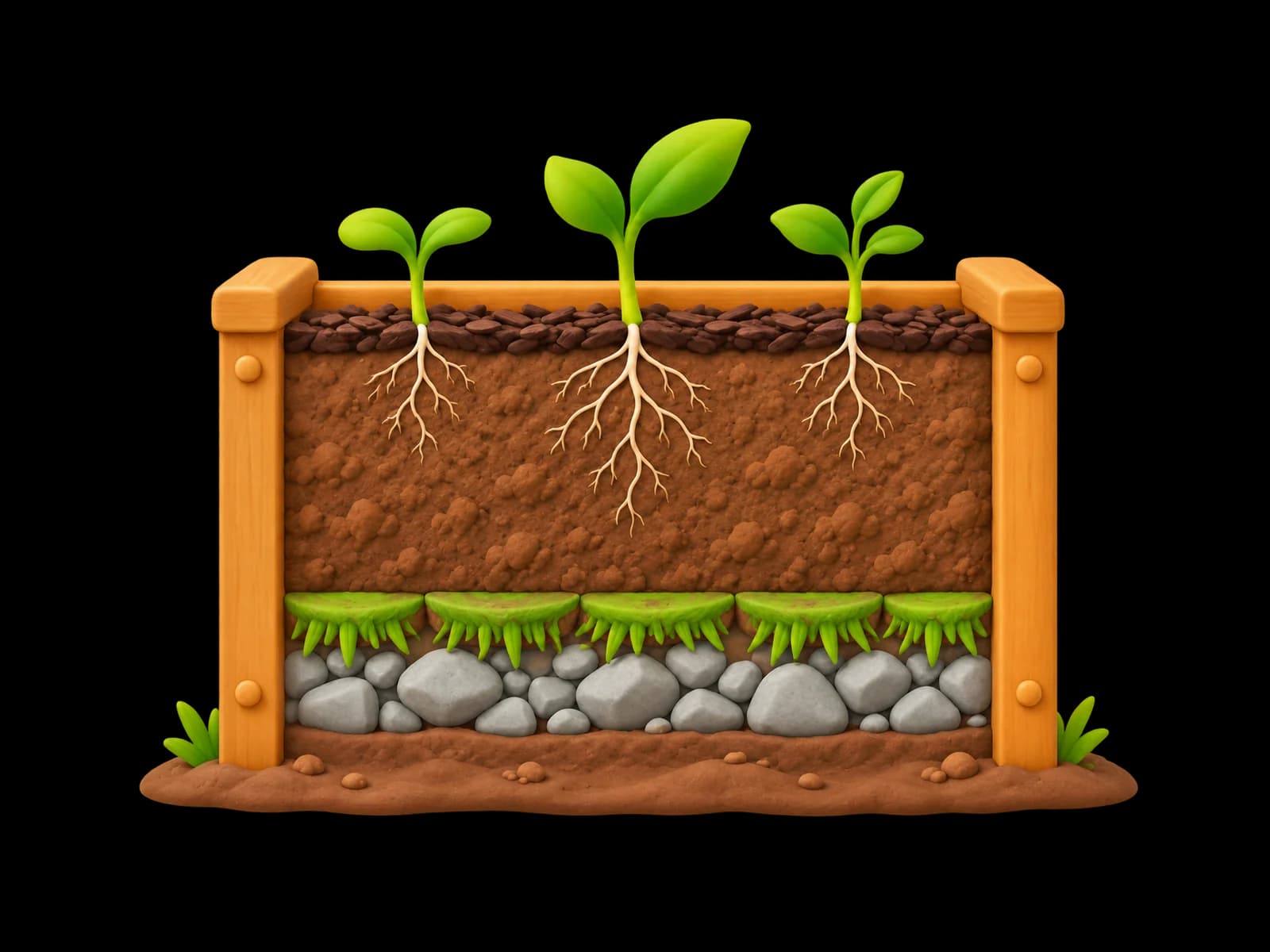
Raised garden bed soil layers: do you need them?
For a typical vegetable bed less than 50 cm deep, no. One well-mixed fill from top to bottom gives roots the same good soil all the way down. Layers only come in at the base of deep beds, as above.
You may read about two layered methods. Lasagne beds are built from alternating layers of different organic materials. Hugelkultur buries logs and branches under the soil. Some gardeners use them, but neither is covered by RHS guidance, and we have found no authoritative UK advice on either, so we cannot say how well they work in a vegetable bed. If you try one, treat it as an experiment.
What to fill raised beds with: the RHS mix
| Ingredient | Parts by volume | Notes |
|---|---|---|
| Topsoil | 7 | Screened, ideally with an analysis |
| Organic matter | 3 | Garden compost, leafmould or well-rotted manure |
| Horticultural sharp sand | 2 (4 on a hard surface) | Washed and gritty, not builders' sand |
The RHS says this suits most raised beds, and BBC Gardeners' World gives the same 3:2:7 ratio. Our guide to the best soil for raised beds explains topsoil grades, peat-free compost and pH.
Can you fill a raised bed with just compost?
You can, but you will be disappointed. RHS adviser Leigh Hunt recommends filling mainly with soil because soil does not break down, while garden compost and potting compost slump within a few seasons. Gardeners' World adds that as compost compacts it leaves a raised rim of timber that can shade young plants.
There is no reliable published figure for how far a compost-only bed sinks, so we will not give one. Note too that the RHS treats seed and potting composts as separate products that are not meant as soil improvers.
The cheapest ways to fill a raised bed in the UK
- Your own soil. The RHS suggests soil from nearby borders, enriched with a couple of bucketfuls of manure per square metre.
- Your own compost and leafmould. Free, though leafmould is low in nutrients.
- Council green-waste compost. Councils and contractors often sell it; look for the PAS 100 quality specification.
- Spent mushroom compost, usually sold by mushroom farms.
- Stable manure. Compost it before use, and never put fresh manure where salads or other crops eaten raw will grow.
- Rubble or subsoil in the base of deep beds, so less bought soil is needed.
Free manure and compost can occasionally carry weedkiller residue. The RHS suggests a germination test (sowing a few seeds in a sample) before you fill the whole bed. Bulk bags vary in size between suppliers, so compare the stated volume rather than the number of bags.
Step by step: how to fill a raised bed for vegetables
1. Work out the volume
Measure inside the frame and calculate the litres you need, as above.
2. Prepare the base
Strip turf and lightly fork the soil, or lay cardboard on grass. In beds over 50 cm deep, add rubble or subsoil and upturned turves. On paving, make sure water can escape.
3. Line untreated timber if you want to
Use old compost bags or recycled plastic, with a permeable base or drainage holes.
4. Mix the soil
Mix topsoil, organic matter and sand in a 7:3:2 ratio, on a tarpaulin or in a wheelbarrow, so it is even throughout.
5. Fill and firm
Add the mix in stages, firming gently as you go, until the surface is about 5 cm below the rim.
6. Leave it to settle
Give it about two weeks. In England, filling in winter means the bed is settled in time for March sowings.
7. Top up and plant
Top up low spots, rake level and start sowing.
Settling and topping up: how full should a raised bed be?
The two big UK sources differ slightly. The RHS fills to about 5 cm below the rim, firms, waits a couple of weeks and tops up before planting. BBC Gardeners' World fills right to the top and also waits two weeks. Both agree that the soil settles and that you should let it before sowing. A 5 cm gap leaves room for mulch later.
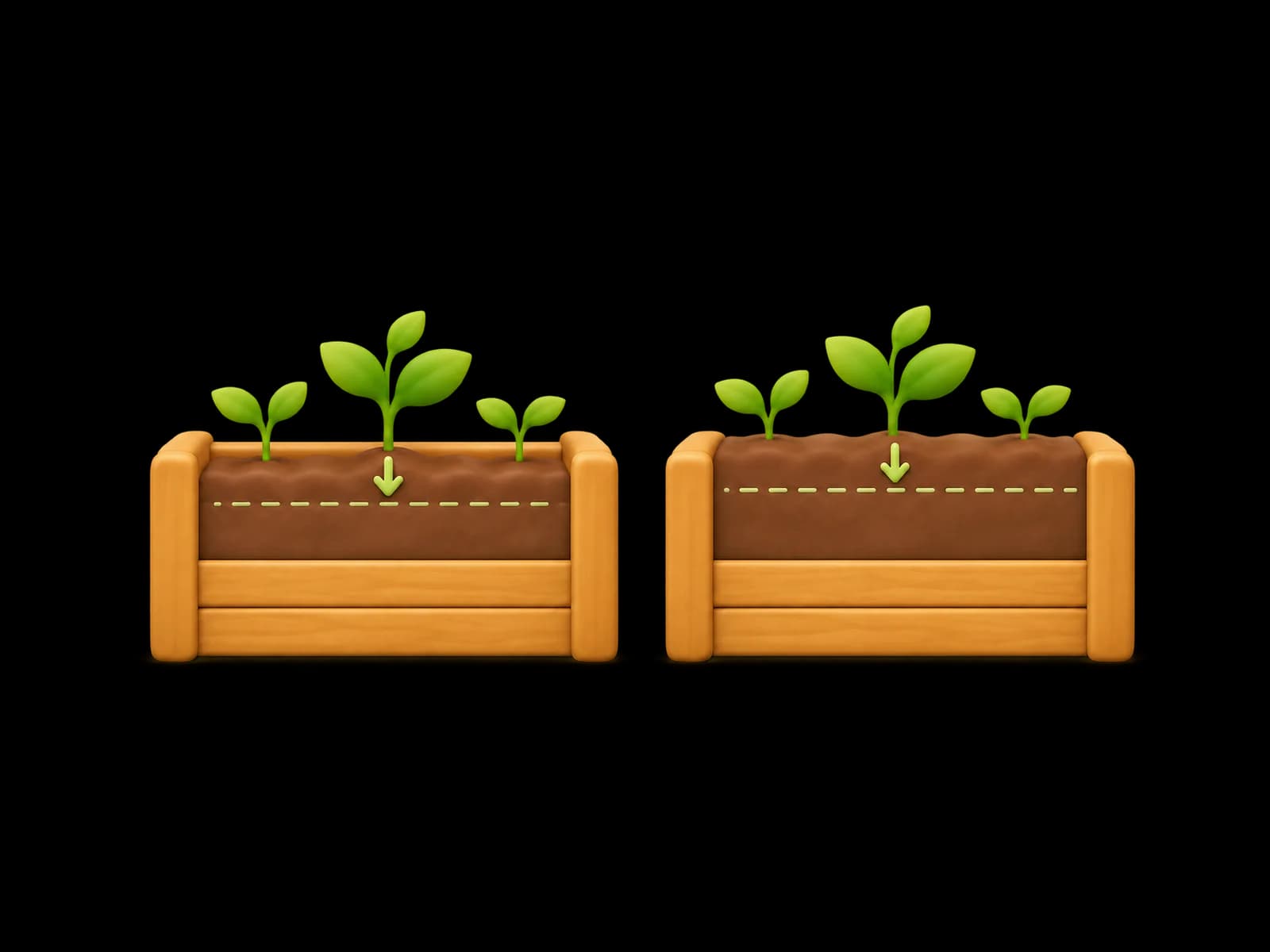
After the first year, topping up is part of routine care. For no-dig beds the RHS adds about 5 cm of organic matter every year, usually in autumn after cropping. On a 1.2 × 2.4 m bed, a 5 cm layer works out at 144 litres.
After filling: plan what goes in
With the bed settled, decide what to grow and where. Our raised bed layout ideas show sample plans, what to grow in a raised bed suggests easy crops for England, and how deep a raised bed should be explains which crops need the most soil. New to all of this? Start with our beginner's guide to raised bed vegetable gardening.
If you would rather not draw the plan by hand, Sowstory will lay out your newly filled bed to scale, tell you how many plants fit and when to sow them. It is coming soon to the App Store, and your first bed is free.