
The best raised bed soil for vegetables is mostly good topsoil with organic matter and sand mixed in: the RHS suggests about 7 parts topsoil, 3 parts organic matter and 2 parts horticultural sharp sand. On concrete or paving the RHS doubles the sand to 4 parts, and peat-free compost or garden compost works well as the organic part.
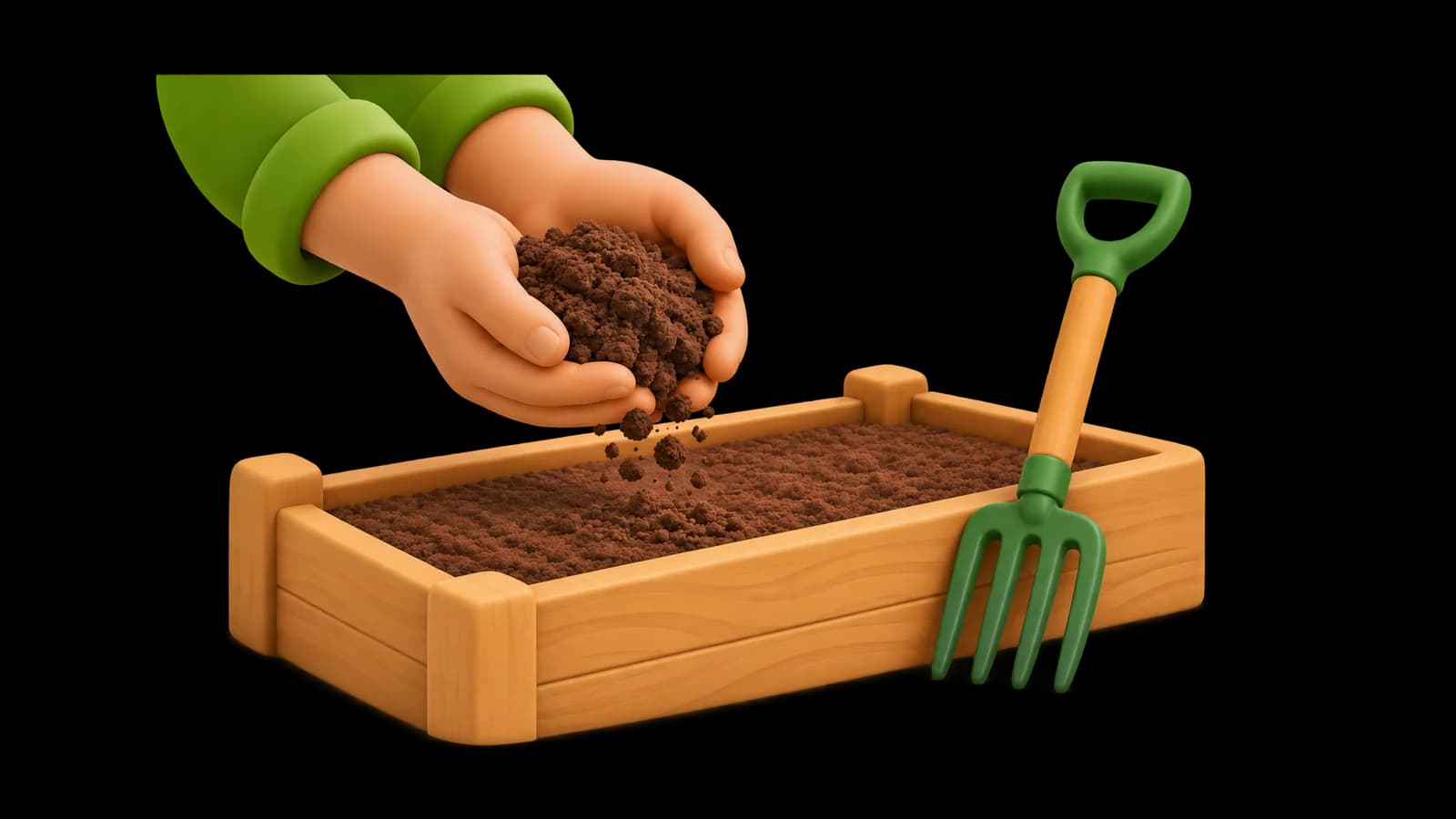
This guide explains what vegetables need from the soil, the RHS mixes, whether garden soil will do, how to buy topsoil, where peat-free compost stands in England, and pH.
What vegetables need from raised bed soil
Vegetables grow best in soil that holds moisture and nutrients but still drains. The RHS describes loam, a mix of clay, sand and silt, as the ideal: fertile, free-draining and easy to work. Clay holds water and nutrients but drains and warms slowly. Sandy soil warms early but dries out and is low in nutrients. Chalky soil is alkaline and free-draining, and organic matter breaks down quickly in it.
Organic matter is what pulls all of these towards loam. The RHS suggests aiming for 3–6% soil organic matter, and notes that most soils in southern England have less than 2%. That is why every recommended raised bed mix includes compost or manure.
The RHS raised bed soil mix (3:2:7)
| Part | What to use | Parts by volume |
|---|---|---|
| Organic matter | Garden compost, leafmould or well-rotted manure | 3 |
| Sharp sand | Washed, gritty horticultural sharp sand (not builders' sand) | 2 |
| Topsoil | Screened topsoil, ideally with an analysis | 7 |
The RHS says this mix suits most raised beds, and BBC Gardeners' World gives the same 3:2:7 ratio. For herbs, alpines and bulbs, the RHS doubles the sand for sharper drainage.
As an example, a 1.2 × 2.4 m bed filled 30 cm deep needs 864 litres. Split 3:2:7, that is 216 litres of organic matter, 144 litres of sand and 504 litres of topsoil. The raised bed soil calculator gives the split for other bed sizes.
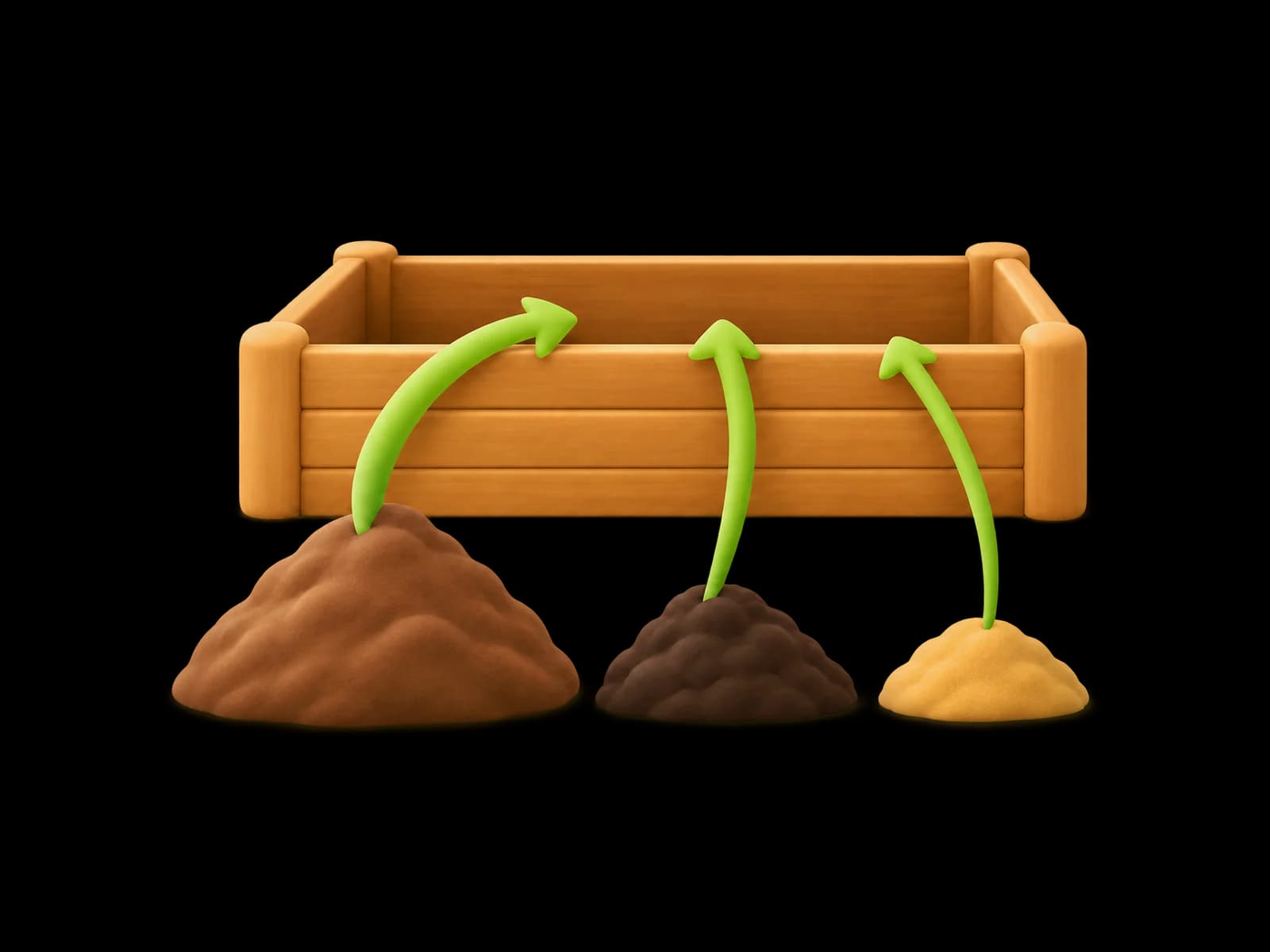
Soil mix for a raised bed on a hard surface (3:4:7)
On concrete, paving or a patio, water cannot drain away into the ground below. For these beds the RHS suggests about 3 parts organic matter, 4 parts sharp sand and 7 parts topsoil. Drill plenty of drainage holes in timber sides, and refresh or replace the soil regularly so it keeps draining.
For the same 864-litre bed, that split is roughly 185 litres of organic matter, 247 litres of sand and 432 litres of topsoil. Gardeners' World adds that a rubble or crock layer in the base only makes sense in beds deeper than 50 cm, because shallower beds need all their depth for roots. The RHS gives no minimum depth for beds on hard surfaces; see how deep a raised bed should be.
Raised bed soil vs garden soil
You do not have to buy everything. The RHS suggests a cheap filling of soil from nearby borders, enriched with a couple of bucketfuls of manure per square metre. That works well if your garden soil is reasonable and free of perennial weed roots.
If your soil is heavy clay or very sandy, do not try to fix it by mixing in sand or clay. The RHS says adding organic matter is far more practical. On chalky or clay ground, Gardeners' World suggests filling with soil-based compost, council green-waste compost and topsoil instead.
What you should not do is fill the bed mainly with compost. RHS adviser Leigh Hunt recommends mostly soil because, unlike garden or potting compost, it does not break down and slump within a few seasons. Gardeners' World adds that soil-based mixes hold nutrients better than lighter growing media. Our guide to filling a raised bed covers this in more detail.
Buying topsoil: what BS 3882 means
BS 3882 is the British Standard specification for topsoil that is moved or sold. The current edition, BS 3882:2015, sets requirements for texture, acidity and contaminants, and for how topsoil is sampled, tested and handled. It defines a multipurpose topsoil suitable for most uses, plus specific-purpose topsoils that are low in fertility, acidic or calcareous.
You may also see older grade names. The RHS topsoil buying guide still refers to the 2007 edition, with premium, general-purpose and economy grades. Under those 2007 criteria, premium topsoil had a pH of 5.5–7.8 and the other two 5.0–8.2.
Whichever edition a supplier quotes, the RHS advice is practical:
- Ask where the soil came from and for an analysis report.
- Look at it before you buy, checking for stones, thick roots, weeds and rubbish such as glass or brick.
- Be wary of imported soil bringing in Japanese knotweed or couch grass.
- Allow at least 20 cm of topsoil for a new bed.
Organic raised bed soil: choosing the organic matter
Here "organic" means the compost, manure and leafmould that feed the soil. (If you want certified organic products, check the labelling.) Good sources:
- Garden compost from your own heap.
- Well-rotted manure. Compost fresh manure first; the RHS says never to use fresh manure where salads or other crops eaten raw will grow.
- Council green-waste compost. Tends to be rich in nutrients but varies through the year. The PAS 100 specification sets minimum quality criteria for it.
- Spent mushroom compost, usually sold by mushroom farms.
- Bagged composts, which are heat-treated and less likely to carry weed seeds than manure.
Leafmould is useful but low in nutrients, so the RHS rates it better for ornamentals than for vegetables. If you suspect manure or compost may carry weedkiller residue, the RHS suggests a simple germination test: sow a few seeds in a sample before filling the whole bed.
Peat-free compost in England: where things stand
In August 2022 the government announced that sales of peat to amateur gardeners in England would be banned by 2024. That ban has not become law. The RHS says no legislation currently bans peat use in horticulture and the timeline is unclear. The Peat-free Partnership, a coalition of organisations, notes that the 2024 deadline passed with no legislation in any UK nation, and that government documents in late 2025 repeated the commitment to legislate "when parliamentary time allows".
In practice, peat-free compost is easy to find. RHS peat-free policies for its shows, gardens and retail took effect in 2026, and the RHS reports that 70% of gardeners who bought compost chose peat-free. Peat-free mixes are made from wood fibre, coir, composted bark and green waste, often with loam and sand. The RHS advises using them within the season you buy them and expecting to adjust how you water and feed.
The classic mix for square foot gardening includes peat moss; the Square Foot Gardening Foundation lists coconut coir as a substitute.
Soil pH for raised beds
Most vegetables are happy in neutral soil. The RHS gives pH 6.5 as the best general-purpose figure, because nutrients are most available and soil life most active there, and says soil between 6.1 and 7.0 usually needs no adjustment. Lime raises pH; sulphur is the usual way to lower it.
Test before you add anything, and not within three months of adding lime, fertiliser or organic matter. If you plan to grow brassicas such as cabbages and kale, the RHS suggests considering lime when the pH is below 5.5.
Keeping raised bed soil good year after year
- Mulch every year. For no-dig beds the RHS adds about 5 cm of organic matter each year. As a mulch it recommends at least 5 cm, and about 7.5 cm for biodegradable mulches.
- Pick your timing. RHS pages differ: one says the annual mulch usually goes on in autumn after cropping, another prefers late winter to early spring so rain does not wash out nitrogen. Either works; what matters is doing it on moist, weeded soil that is not frozen.
- Feed as needed. Gardeners' World suggests starting with a slow-release fertiliser and using a liquid feed later if plants need it.
- Top up the level. Soil and compost settle over time, so add organic matter to keep the surface near the rim.
Once the soil is in
Good soil is the foundation; the next step is deciding what goes where. Our raised bed layout ideas show sample plans, and the vegetable spacing chart gives row and plant gaps for each crop.
If you would rather not draw the plan yourself, Sowstory will lay out your filled bed to scale, tell you how many plants fit and when to sow them in England. It is coming soon to the App Store, and your first bed is free.
Sources
- RHS: How to make a raised bed
- RHS: Growing vegetables in raised beds
- RHS: Soil types
- RHS: Organic matter, how to use it in the garden
- RHS: Topsoil buying guide
- RHS: Soil pH and testing
- RHS: February jobs, grow your own
- RHS: Peat-free compost choices
- RHS: Retail peat-free from January 2026
- RHS: No-dig gardening
- RHS: Mulches
- BSI: BS 3882:2015 Specification for topsoil
- GOV.UK: Sale of horticultural peat to be banned (27 August 2022)
- Peat-free Partnership: Legislation timeline
- Square Foot Gardening Foundation: The method
- BBC Gardeners' World: Gardening tips for raised beds
- BBC Gardeners' World: How to make a vegetable patch