
A raised bed vegetable garden is a framed bed of good soil, ideally less than 1.5 m wide so you can reach the middle, at least 30 cm deep for salads, and placed where it gets more than six hours of direct sun in summer. In England you can build it at any time of year, make the first outdoor sowings in March, and plant tender crops such as runner beans and courgettes once frost risk has passed, from May in the far south to early June in the north-east.
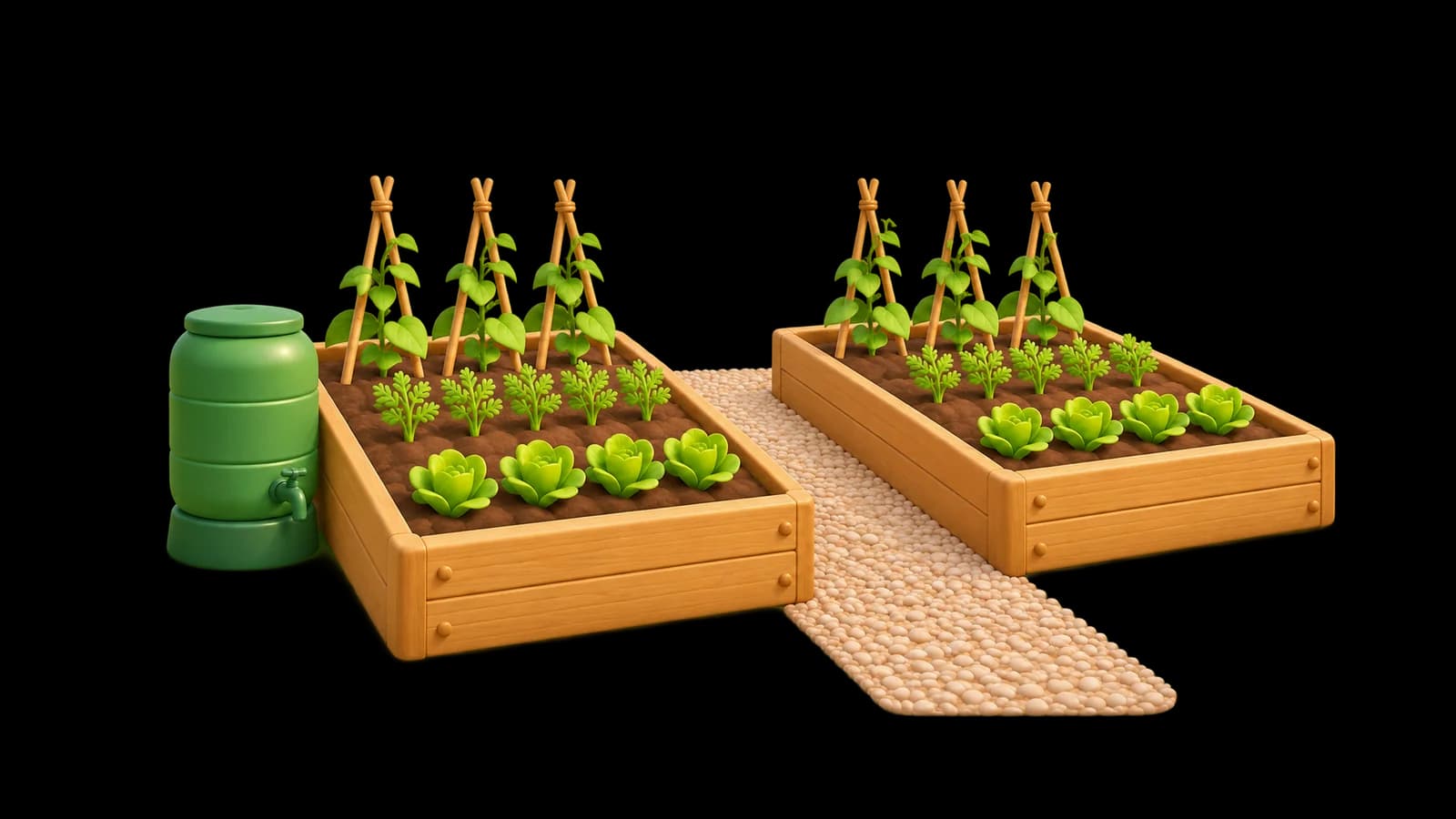
This beginner's guide covers why raised beds work, where to put one, what size and depth to build, how to fill it, what to grow first and a simple first-year plan for a 1.2 × 2.4 m bed (about 4 × 8 ft). Each section links to a more detailed guide when you need it.
Why grow vegetables in raised beds?
Raised beds solve a few problems that put many beginners off growing vegetables:
- Poor or heavy ground stops mattering. The RHS notes that raised beds improve growing conditions on poor soil and on heavy soil that waterlogs. Perennial crops such as rhubarb and asparagus are less likely to rot in a wet winter.
- An earlier start. The soil in a raised bed warms up sooner in spring than cold clay, so you can sow earlier.
- Easy to protect. A defined bed is simple to cover with fleece against frost or with mesh against insects.
- Less bending, no trampling. You work from the paths, so the soil stays loose and the bed suits people with limited mobility.
- Simpler rotation. Separate beds make it easier to move crop groups around each year.
There are two honest drawbacks. Raised beds dry out faster than open ground, so you will water more, and the frame and soil cost money; the RHS points out that bagged topsoil works but is expensive. Note too that a frame holding soil at the same level as the ground around it is not really a raised bed, and gives none of the drainage benefit.
Where to put a raised bed
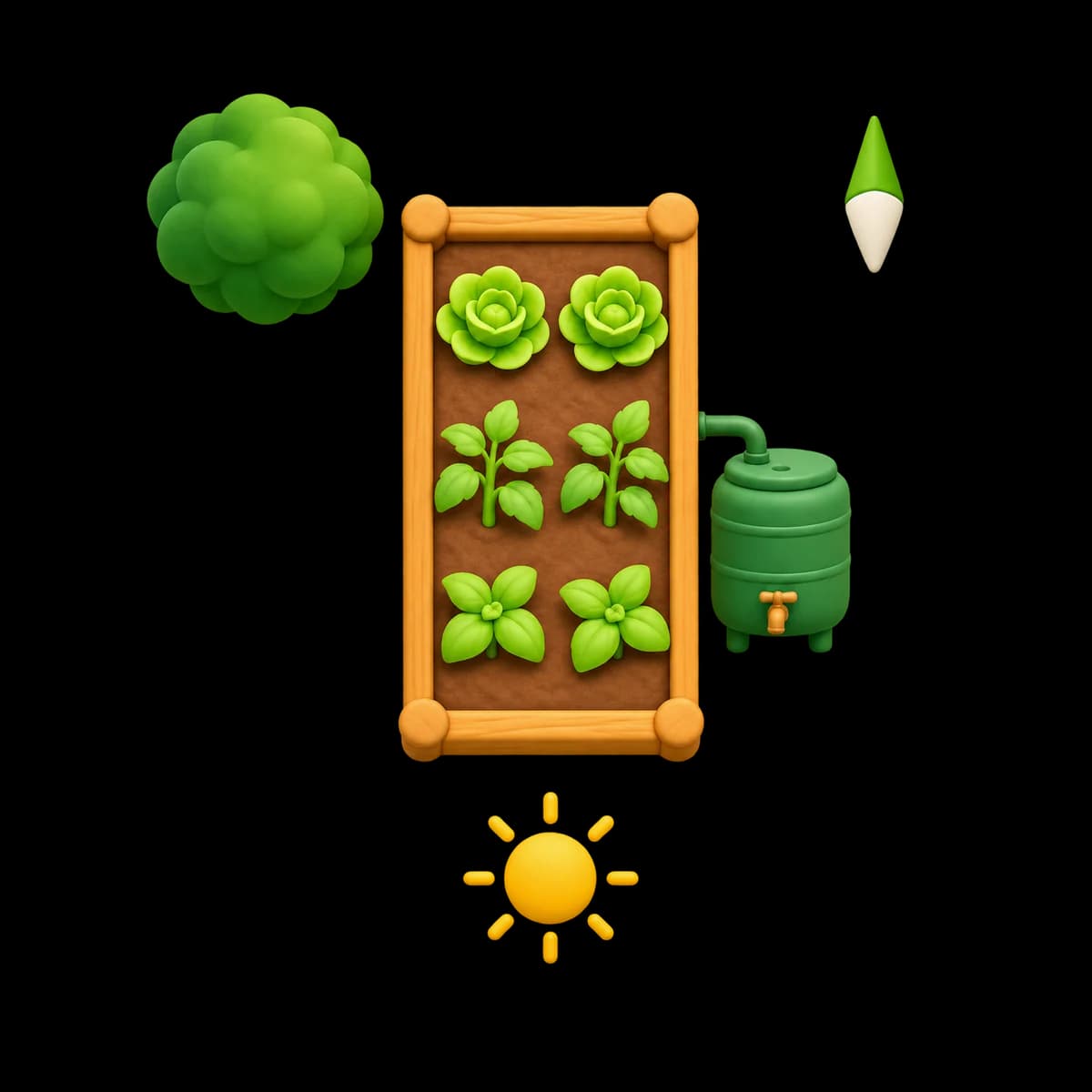
Sun matters more than anything else. The RHS defines full sun as more than six hours of direct sun a day at midsummer, and fruiting vegetables need it. A south- or west-facing spot away from overhanging trees is ideal. Large trees and hedges also compete with your crops for water and food.
A few more siting points:
- Run long beds north to south so both sides get even light through the day (RHS).
- Keep it level and sheltered from the strongest winds, and close to a tap or water butt (BBC Gardeners' World).
- Watch walls and fences. A bed right against one can sit in a rain shadow and need extra watering.
- Avoid frost pockets. Cold air flows downhill and gathers at the lowest point or against a solid barrier, so a bed at the bottom of a slope is colder.
- Choose free-draining ground. On heavy clay that waterlogs, the RHS suggests building in late summer, when the ground is drier.
If your best spot only gets three to six hours of sun (partial shade), grow leafy crops there. The RHS lists lettuce, spinach, chard, kale, beetroot, peas and baby carrots among the vegetables fairly tolerant of light shade; tomatoes and other fruiting crops suffer most.
What size and depth to build
Width is the key measurement. The RHS says beds under 1.5 m wide let you reach the centre without stepping on the soil, and Gardeners' World gives about 1.5 m as the maximum. A width of 1.2 m keeps the middle within easy reach from either side. There is no recommended length; the RHS suggests several smaller beds rather than one long run. Leave paths at least 45 cm wide for a wheelbarrow, or at least 1 m if you need wheelchair access. Our guide to raised bed sizes covers widths, lengths, heights and allotment beds.
Depth depends on what you grow. The RHS says about 30 cm is deep enough for salad leaves, and most plants need 45 cm or more. Gardeners' World says the depth of a single scaffold board is enough for vegetables. Sowstory checks for at least 30 cm before planning early carrots or first early potatoes, and 20 cm for radishes. See how deep a raised bed should be for the details.
Materials. Pressure-treated softwood sleepers are an economical choice that lasts many years, and the RHS considers new treated timber safe for edible crops. Scaffold boards are the cheapest option but do not last as long. Do not use old creosote- or tar-treated railway sleepers. If you would like to sit on the edge while you work, Gardeners' World suggests a bed about 40–50 cm high.
How to fill a raised bed
Fill mostly with soil, not compost. The RHS recommends a mix of roughly 3 parts organic matter (garden compost, leafmould or well-rotted manure), 2 parts horticultural sharp sand and 7 parts topsoil, and Gardeners' World gives the same ratio. Compost on its own breaks down and slumps within a few seasons, leaving the soil level well below the rim.
The RHS fills to about 5 cm below the rim, firms the soil, leaves it to settle for a couple of weeks and tops it up before planting. Gardeners' World fills right to the top and also waits two weeks. Either way, let it settle before you sow.
To see how much you need, a 1.2 × 2.4 m bed filled 30 cm deep holds 0.864 m³, or 864 litres. The raised bed soil calculator has the figures for other sizes and depths, how to fill a raised bed covers layers and cheap ways to fill, and the best soil for raised beds explains topsoil grades and peat-free compost.
What to grow in your first raised bed
Start with quick, forgiving crops that you like eating. These all suit a first bed in England; the months are when Sowstory lets you start each crop in the bed (sowing direct or planting out), and the spacing is Sowstory's planning rule.
| Crop | Starts in the bed | Rows apart | Plants apart |
|---|---|---|---|
| Radish | March to August | 15 cm | 2.5 cm |
| Loose-leaf lettuce | March to August | 25 cm | 15 cm |
| Early carrots | March to July | 20 cm | 5 cm |
| Spring onions | March to August | 10 cm | 8 cm |
| Beetroot | April to July | 30 cm | 10 cm |
| Dwarf peas | March to June | 60 cm | 7.5 cm |
| Runner beans (north edge, on canes) | May to June | one row | 25 cm |
| Bush courgette | June | 90 × 90 cm per plant | |
| Garlic | October to December | 25 cm | 15 cm |
Two notes for beginners. First, one courgette plant takes a big share of a small bed, and Sowstory plans at most two in one bed. Second, radishes, lettuce and spring onions tolerate four to six hours of sun, while carrots, beetroot, peas, beans and courgettes want six or more.
For more choices, see what to grow in a raised bed, and check row and plant gaps for every crop in the vegetable spacing chart.
A simple first-year plan for a 1.2 × 2.4 m bed
Here is one way to use a 1.2 × 2.4 m bed through its first year, with rows running along the 2.4 m length and the spacings above. Tall crops go on the north edge, where they will not shade the rest.
| Strip (north to south) | Width used | Spring | Summer | Autumn and winter |
|---|---|---|---|---|
| North edge | 45 cm | A quick row of radishes in March | Runner beans on canes, planted after frost: about 9 plants | Garlic once the beans are cleared, up to December |
| Middle | 2 × 20 cm | Two rows of early carrots from March: about 48 per row | Resow carrots as the first rows are lifted (up to July) | Spinach sown in August or September |
| South edge | 25 cm | A row of loose-leaf lettuce from March or April: about 16 plants | Resow lettuce every few weeks (up to August) | Clear, then mulch |
That uses 1.1 m of the 1.2 m width. The plant counts are simple estimates (row length divided by plant spacing).
How the timing works in England:
- March to April: sow radishes, carrots and lettuce direct. Sowstory reserves about eight weeks of bed space for radishes, so a March row is out before the beans need the strip.
- Late May to early June: plant out runner beans once frost risk has passed. The RHS gives the second half of May for southern England, the end of May for the Midlands, north-west England and Yorkshire, and early June for north-east England. Sheltered or urban gardens can go one to two weeks earlier; exposed, rural or high sites one to three weeks later. Our guide to last frost dates explains how to judge it.
- June to August: fill gaps as crops are cleared, using the vegetable sowing calendar.
- October to December: plant garlic where the beans grew.
Want more variations, including 4 × 4 ft and 3 × 6 ft beds? See our raised bed layout ideas, or the plant spacing calculator for exact plant counts.
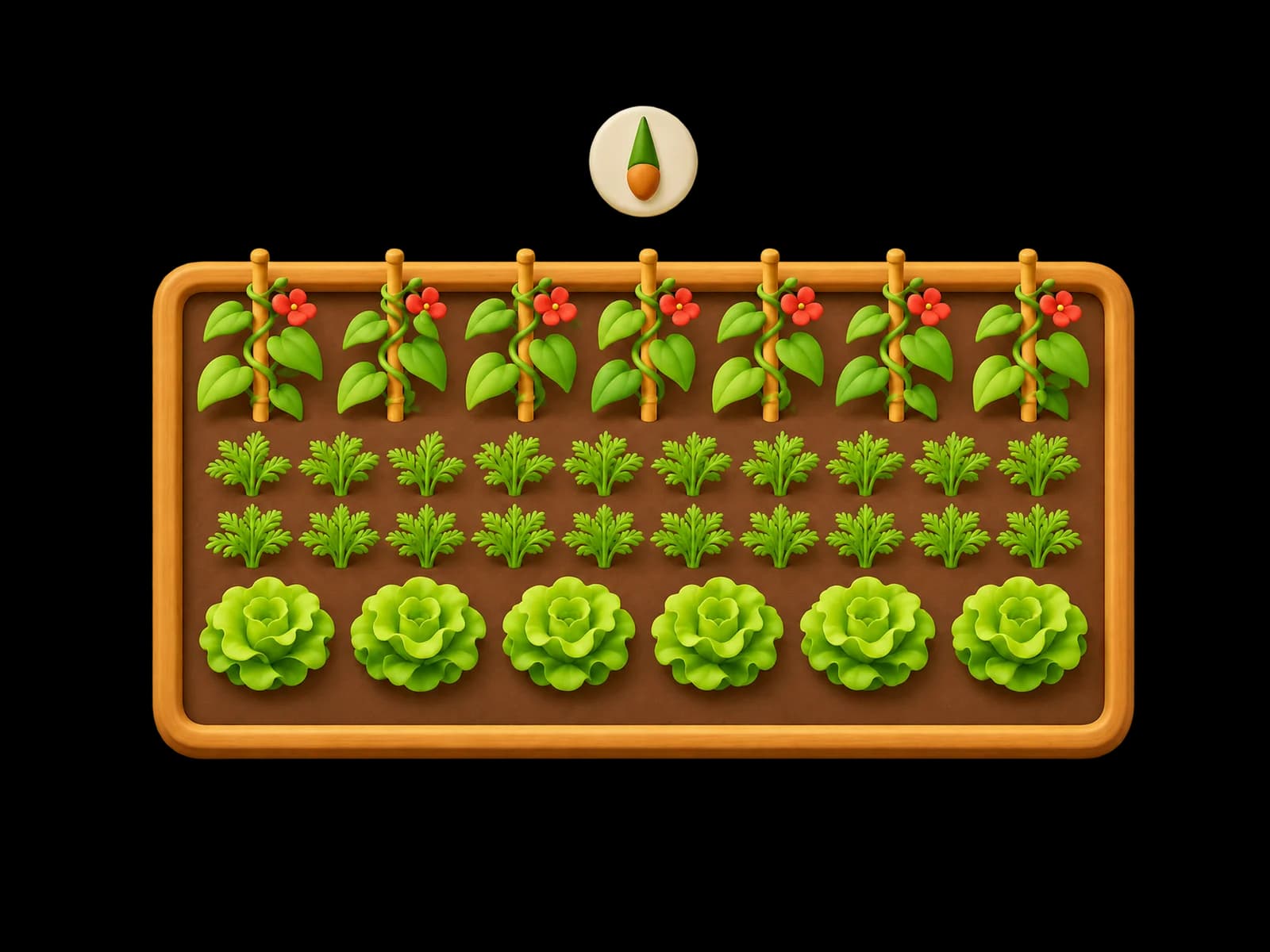
If you would rather not work out the rows and months yourself, Sowstory lays out your bed to scale, tells you how many plants fit and gives you a month-by-month plan for England. It is coming soon to the App Store, and your first bed is free.
Raised bed gardening tips for the first season
- Check moisture before watering. The RHS suggests feeling about a finger's depth into the soil. Water more after warm, windy weather.
- Mulch. A layer of organic mulch holds moisture and suppresses weeds; the RHS recommends at least 5 cm.
- Collect rainwater. Water butts next to the beds save trips with the hose; drip irrigation is a low-effort option.
- Feed lightly. Gardeners' World suggests a slow-release fertiliser at the start and a liquid feed later if plants need it.
- Harden off plants raised indoors. The RHS allows two to three weeks to get them used to outdoor conditions. Hardening off does not make tender plants frost-proof.
- Use fleece in spring. On an allotment, the RHS says fleece brings spring-sown crops forward by about two weeks.
- Top up each year. Spread fresh organic matter over the bed, usually in autumn or late winter, to keep the level up and feed the soil.
- Rotate if you have several beds. The RHS groups crops into potatoes, legumes, onions, roots and brassicas and moves each group on yearly. It says rotation is less practical on very small plots.
Where to go next
- Raised bed sizes: width, length, height and paths.
- How deep should a raised bed be?
- How to fill a raised bed and the raised bed soil calculator.
- Best soil for raised beds.
- Square foot gardening, a grid-based way to plan small beds.
- Vegetable garden layout for planning a whole plot of beds.
- Raised bed planner: how to plan a bed by hand or with the app.
Sources
- RHS: How to make a raised bed
- RHS: Growing vegetables in raised beds
- RHS: Shade gardening
- RHS: Positioning vegetables
- RHS: Frost damage
- RHS: When to plant out tender plants
- RHS: Hardening off tender plants
- RHS: Mulches
- RHS: Crop rotation
- RHS: Allotments, making the most of your plot
- BBC Gardeners' World: Gardening tips for raised beds
- BBC Gardeners' World: How to make a vegetable patch
- Sowstory knowledge base, release v1.4