
To calculate how many plants fit your bed, divide the length of each row by the gap between plants, divide the bed's width by the gap between rows, and multiply the two. This page sets out that plant spacing calculator method step by step, with the answers already worked out for 45 crops at the spacings Sowstory uses.
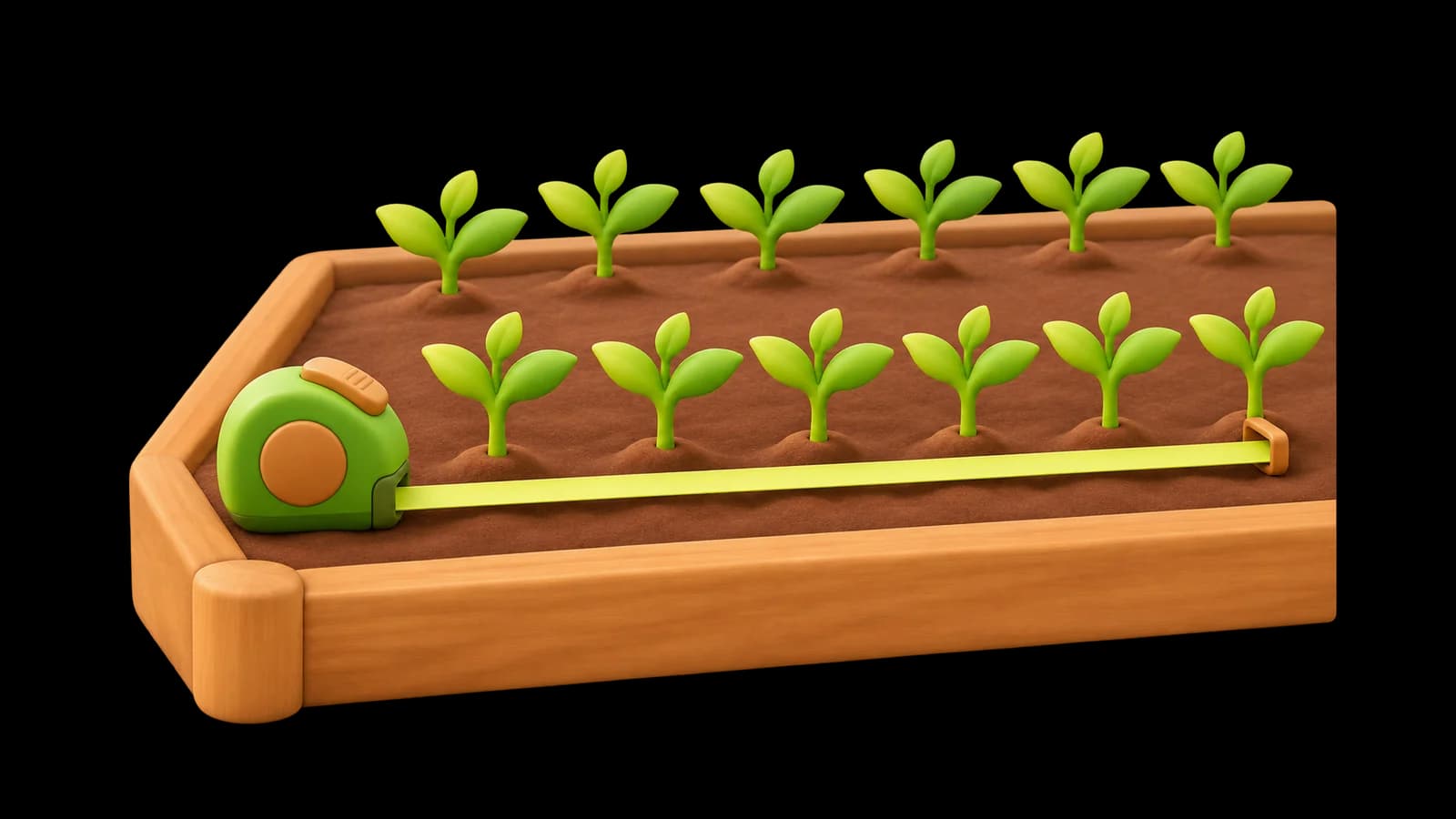
All figures are in centimetres and assume you measure the inside of the bed. Results are rounded down, because a plant squeezed against the timber edge rarely does well.
The three formulas
1. Plants per row
Plants per row = row length ÷ plant spacing (round down)
Example: a 2.4 m (240 cm) row of garlic at 15 cm apart: 240 ÷ 15 = 16 cloves.
2. Rows across the bed
Rows = bed width ÷ row spacing (round down)
Example: a 1.2 m (120 cm) bed of garlic in rows 25 cm apart: 120 ÷ 25 = 4.8, so 4 rows fit, though Sowstory plans no more than 3 rows of garlic in one bed so there is room for other crops.
3. Plants grown on their own (cabbages, tomatoes, courgettes)
Plants = (bed width ÷ spacing) × (bed length ÷ spacing), each rounded down
Example: compact summer cabbages at 45 × 45 cm in a 120 × 240 cm bed: 2 × 5 = 10 plants if the whole bed were cabbages.
Plants per metre of row (row crops)
| Crop | Row spacing | Plant spacing | Plants per 1 m of row |
|---|---|---|---|
| Radish | 15 cm | 2.5 cm | 40 |
| Carrot | 20 cm | 5 cm | 20 |
| Spring onion | 10 cm | 8 cm | 12 |
| Mangetout (seeds) | one row | 7.5 cm | 13 |
| Dwarf pea (seeds) | 60 cm | 7.5 cm | 13 |
| Beetroot | 30 cm | 10 cm | 10 |
| Baby turnip | 30 cm | 10 cm | 10 |
| Onion sets | 25 cm | 10 cm | 10 |
| Garlic | 25 cm | 15 cm | 6 |
| Loose-leaf lettuce | 25 cm | 15 cm | 6 |
| Spinach | 30 cm | 15 cm | 6 |
| Kohlrabi | 30 cm | 15 cm | 6 |
| Salad rocket | 20 cm | 15 cm | 6 |
| Parsnip | 40 cm | 20 cm | 5 |
| Dwarf French bean | 50 cm | 20 cm | 5 |
| Parsley | 30 cm | 20 cm | 5 |
| Dill | 30 cm | 20 cm | 5 |
| Leek | 30 cm | 23 cm | 4 |
| Dwarf broad bean | 45 cm | 23 cm | 4 |
| Pak choi | 40 cm | 25 cm | 4 |
| Runner bean or climbing French bean | one cane row | 25 cm | 4 |
| Potato, first or second early | 90 cm | 30 cm | 3 |
| Potato, maincrop | 90 cm | 37 cm | 2 |
Plants per square metre (crops grown as single plants)
| Crop | Space per plant | Plants per m² | Sowstory's limit per bed |
|---|---|---|---|
| Chives | 20 × 20 cm | 25 | up to 6 clumps |
| Basil | 20 × 20 cm | 25 | 2–8 plants |
| Coriander (leaf) | 20 × 20 cm | 25 | 3–12 plants |
| Self-blanching celery | 23 × 23 cm | 16 | 4–16 plants, in a block |
| Hearting lettuce | 30 × 30 cm | 9 | up to 6 |
| Chard | 30 × 45 cm | 6 | up to 5 |
| Compact summer cabbage | 45 × 45 cm | 4 | up to 4 |
| Calabrese | 45 × 45 cm | 4 | up to 4 |
| Sweet pepper or chilli (outdoor) | 45 × 45 cm | 4 | up to 4 |
| Kale, cauliflower, Brussels sprouts, sprouting broccoli | 60 × 60 cm | 1 | 3–4 depending on crop |
| Cordon tomato or trained cucumber | 60 × 60 cm | 1 | up to 3 |
| Courgette (bush) | 90 × 90 cm | 1 | up to 2 |
| Bush tomato | 100 × 100 cm | 1 | up to 2 |
A whole square metre holds only one plant at 60 cm or more because two 60 cm squares need 120 cm. In a real bed these large crops sit along the edges or ends, so a 1.2 × 2.4 m bed fits more than its area alone suggests (see below).
Worked answers for a 1.2 × 2.4 m bed
These are the counts if the whole of a 1.2 × 2.4 m bed (about 4 × 8 ft) were one crop, with rows running along the length:
| Crop | Rows × plants | Total |
|---|---|---|
| Carrots | 4 rows × 48 | 192 |
| Radishes | 4 rows × 96 | 384 |
| Beetroot | 4 rows × 24 | 96 |
| Onion sets | 3 rows × 24 | 72 |
| Garlic | 3 rows × 16 | 48 |
| Leeks | 4 rows × 10 | 40 |
| Loose-leaf lettuce | 3 rows × 16 | 48 |
| Dwarf French beans | 2 rows × 12 | 24 |
| Runner beans (north edge) | 1 cane row × 9 | 9 |
| First early potatoes | 1 row × 8 | 8 |
| Compact summer cabbages | 2 × 5 grid | 10 |
| Cordon tomatoes | 2 × 4 grid | 8 (Sowstory plans up to 3) |
Most people grow several crops in one bed, so you will use a share of these numbers. Add up the row spacings across the width (they must not exceed it), then count plants along each row. Our raised bed layout ideas show mixed beds worked out this way, and the full list of spacings is in the vegetable spacing chart.
If you would rather not do the sums, the Sowstory app is the calculator: give it your bed's inside size and the crops you want, and it lays them out to scale and tells you how many plants or rows fit, including the edge allowances that hand counts skip. It is coming soon to the App Store, and your first bed plan is free.
Plants per square foot
Square foot gardening divides a bed into 30 cm (about one foot) squares and plants each square with a set number of plants instead of rows:
| Plants per 30 cm square | Equivalent spacing |
|---|---|
| 1 | 30 cm apart |
| 4 | about 15 cm apart |
| 9 | about 10 cm apart |
| 16 | about 7.5 cm apart |
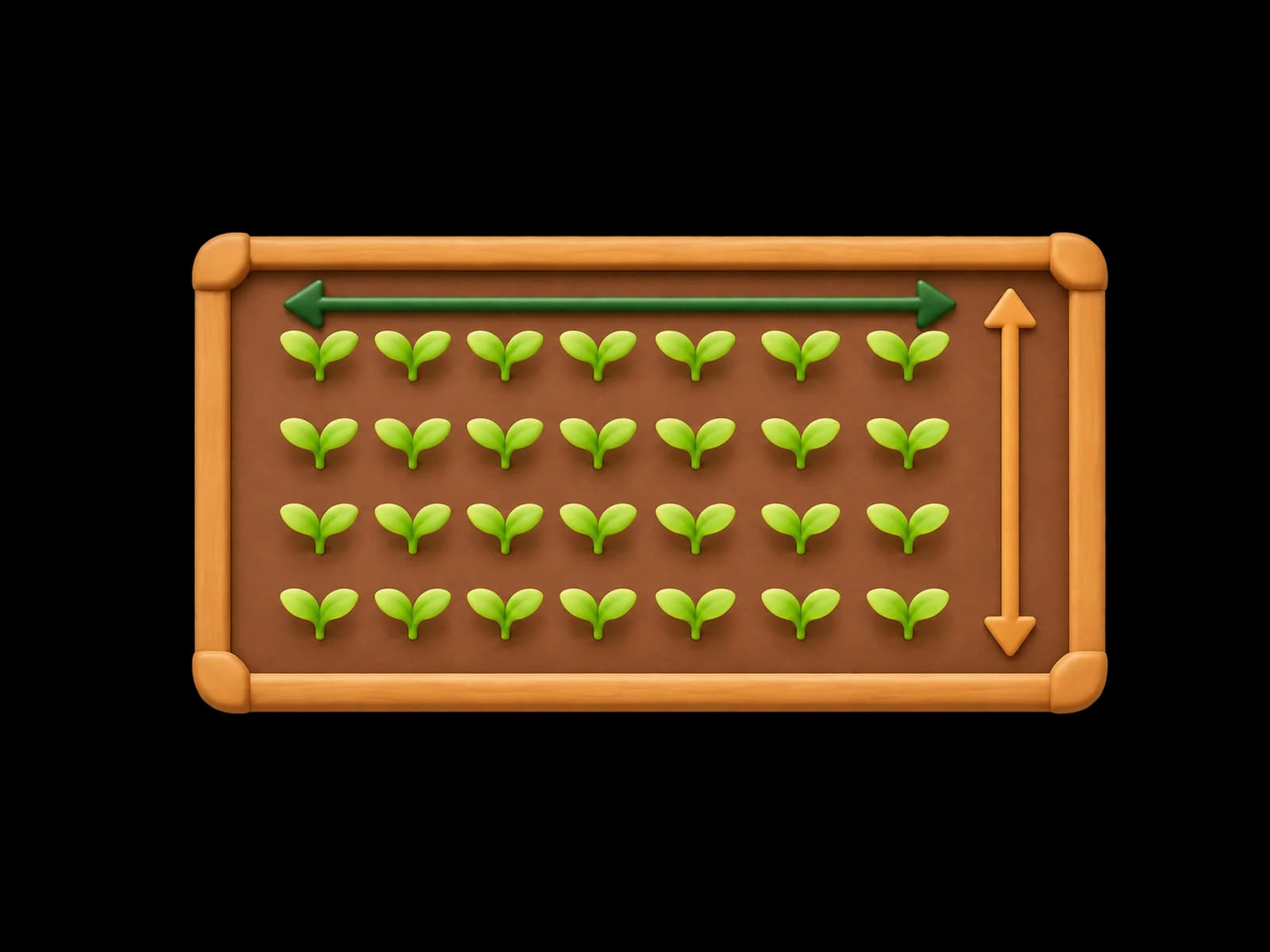
A 1.2 × 1.2 m (4 × 4 ft) bed has 16 squares; a 1.2 × 2.4 m (4 × 8 ft) bed has 32. To use it as a calculator, pick the row from the table nearest your crop's plant spacing. Large plants such as tomatoes, courgettes and brassicas need a whole square or more. Our guide to square foot gardening explains the method and where it works less well.
Getting the inputs right
- Measure inside the frame. A 1.2 m bed built from 5 cm timber has about 1.1 m of soil across it; recalculate with the real figure.
- Check the packet. Varieties differ. Use the spacing on your packet if it is wider than the chart.
- Tall crops first. Place climbing beans, cordon tomatoes and other tall crops on the north edge before you count the rest, as in how far apart to plant tomatoes.
- Soil too. Once you know the layout, work out how much soil the bed needs with the raised bed soil calculator.
Sources
- Sowstory knowledge base, release v1.4 (all spacings and per-bed limits)
- Arithmetic from Sowstory's computed spacing tables (research/seo/sources/COMPUTED-TABLES.md in the Sowstory repository)