
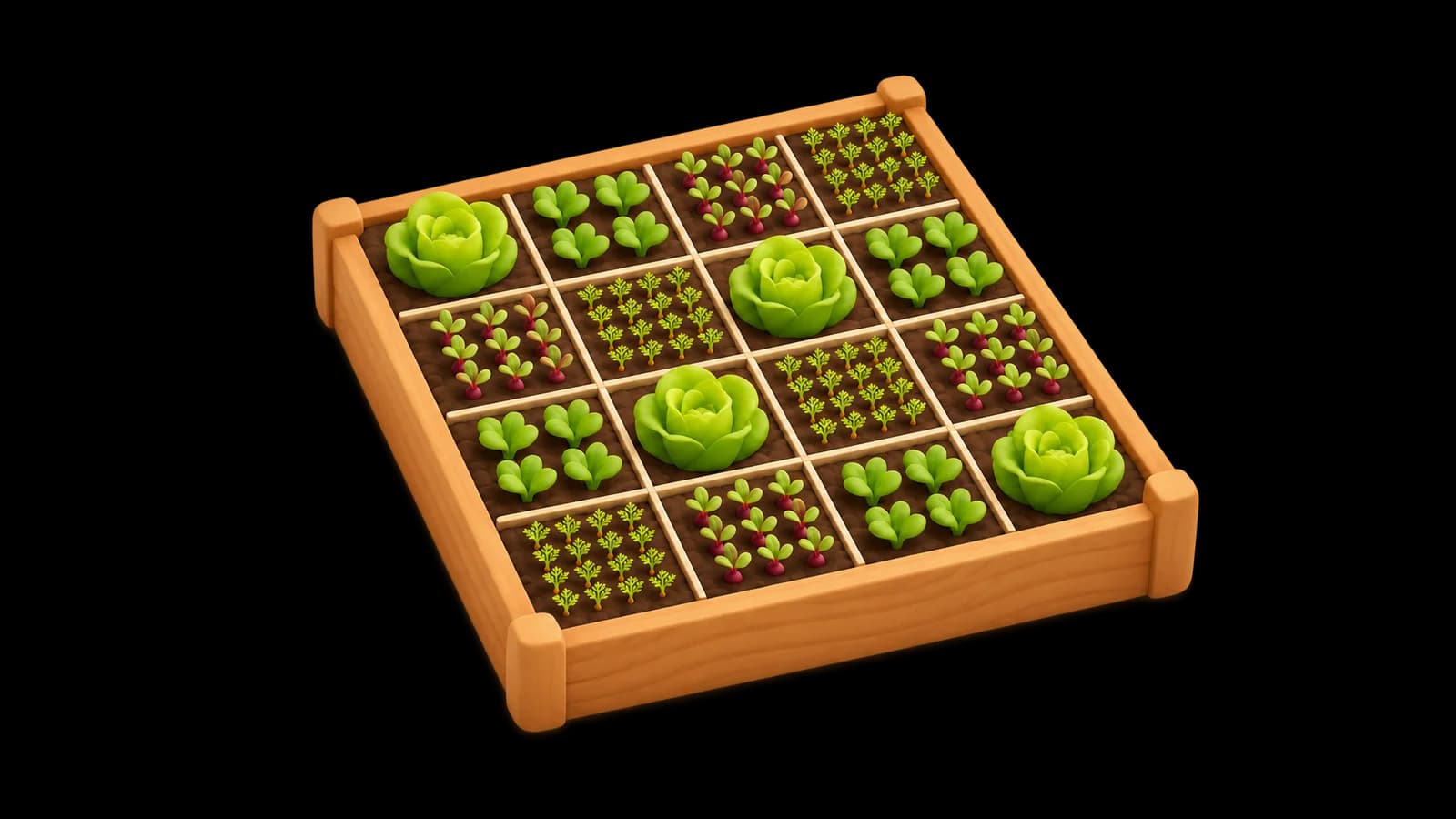
Square foot gardening divides a raised bed into a grid of 1 ft (about 30 cm) squares and plants each square with a single crop at a set number per square, usually 1, 4, 9 or 16 depending on the plant's size, instead of in rows. It suits small, quick crops such as radishes, carrots and lettuce sown in England from March, but large crops such as courgettes, cordon tomatoes and potatoes need several squares each.
This guide explains how the method works, what the plants-per-square rule means in centimetres, how Mel's Mix fits with peat-free gardening in England, and where real crop spacing gives a better answer than the grid.
Where square foot gardening comes from
The method is the work of Mel Bartholomew, a civil engineer and efficiency expert. According to the Square Foot Gardening Foundation, he retired in 1975, joined his local community garden, developed square foot gardening in 1976 and published the book Square Foot Gardening in 1981. He set up the Foundation in 1996. Wikipedia records a second edition, All New Square Foot Gardening, in 2013.
The Foundation makes large claims for the method compared with row gardening: roughly half the cost, a fifth of the space, a tenth of the water and a fiftieth of the work, with no digging, tilling or fertiliser. These are the Foundation's own estimates. We have not found independent figures to test them, so treat them as the method's promise rather than a measured result.
How square foot gardening works
For beginners, the method comes down to five parts:
- A small raised bed. The Foundation's standard bed is 4 × 4 ft. The nearest metric size, 1.2 × 1.2 m, gives 16 squares.
- A visible grid. The Foundation calls the grid one of the method's most important features, because it shows the spacing and keeps the bed organised. Thin wood lath, old Venetian blind slats or yardsticks all work.
- One crop per square, planted at a fixed number per square.
- A light, rich fill called Mel's Mix (see below).
- Sun and drainage. The Foundation asks for a well-drained site with 6–8 hours of direct sun a day.
In metric, make the squares 30 cm. One foot is 30.48 cm, so the difference is small.
The 1, 4, 9, 16 rule as a spacing chart
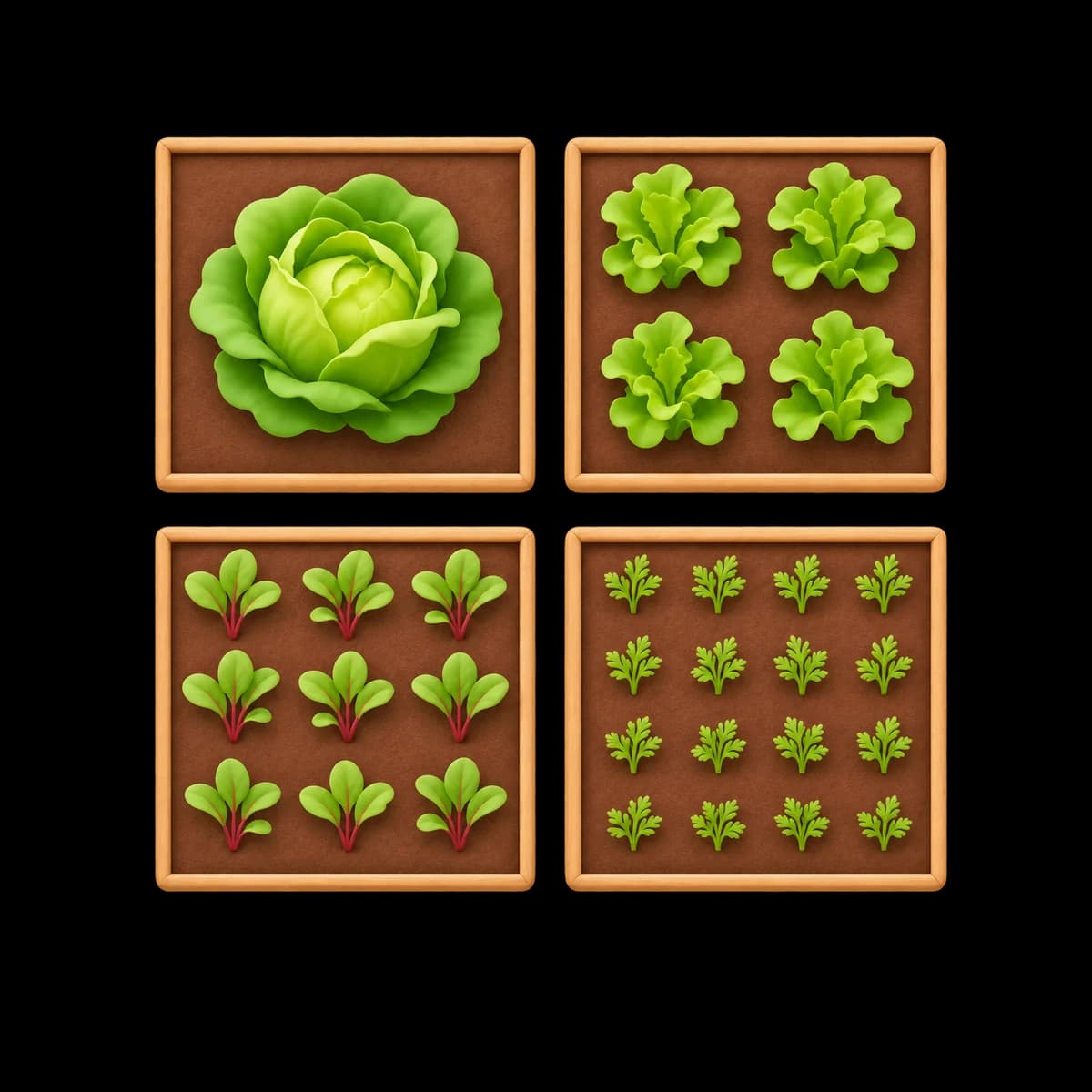
The method's usual convention, as summarised on Wikipedia, is that each square takes 1, 4, 9 or 16 plants according to the plant's mature size. The Foundation's method page points to its own planting chart rather than listing the rule. Converted to spacing in a 30 cm square, and set against the in-row spacing Sowstory uses for the same crops:
| Plants per 30 cm square | Equivalent spacing | Sowstory crops with a similar in-row spacing |
|---|---|---|
| 16 | about 7.5 cm | carrots (5 cm), radishes (2.5 cm), peas and mangetout seed (7.5 cm) |
| 9 | about 10 cm | beetroot, baby turnips and onion sets (10 cm), spring onions (8 cm) |
| 4 | about 15 cm | loose-leaf lettuce, spinach, garlic, kohlrabi and salad rocket (15 cm) |
| 1 | 30 cm | hearting lettuce (30 × 30 cm) |
The difference is the gap between rows. A grid sets plants the same distance apart in both directions. Sowstory sets carrots 5 cm apart in the row but leaves 20 cm between rows, and plans no more than four carrot rows in a bed. In a 1.2 × 1.2 m bed, that gives 4 rows × 24 carrots = 96, where a bed of 16 squares at 16 per square would hold 256. The grid is far denser. For the full list of row and plant gaps, see our vegetable spacing chart.
The limits: large crops need many squares
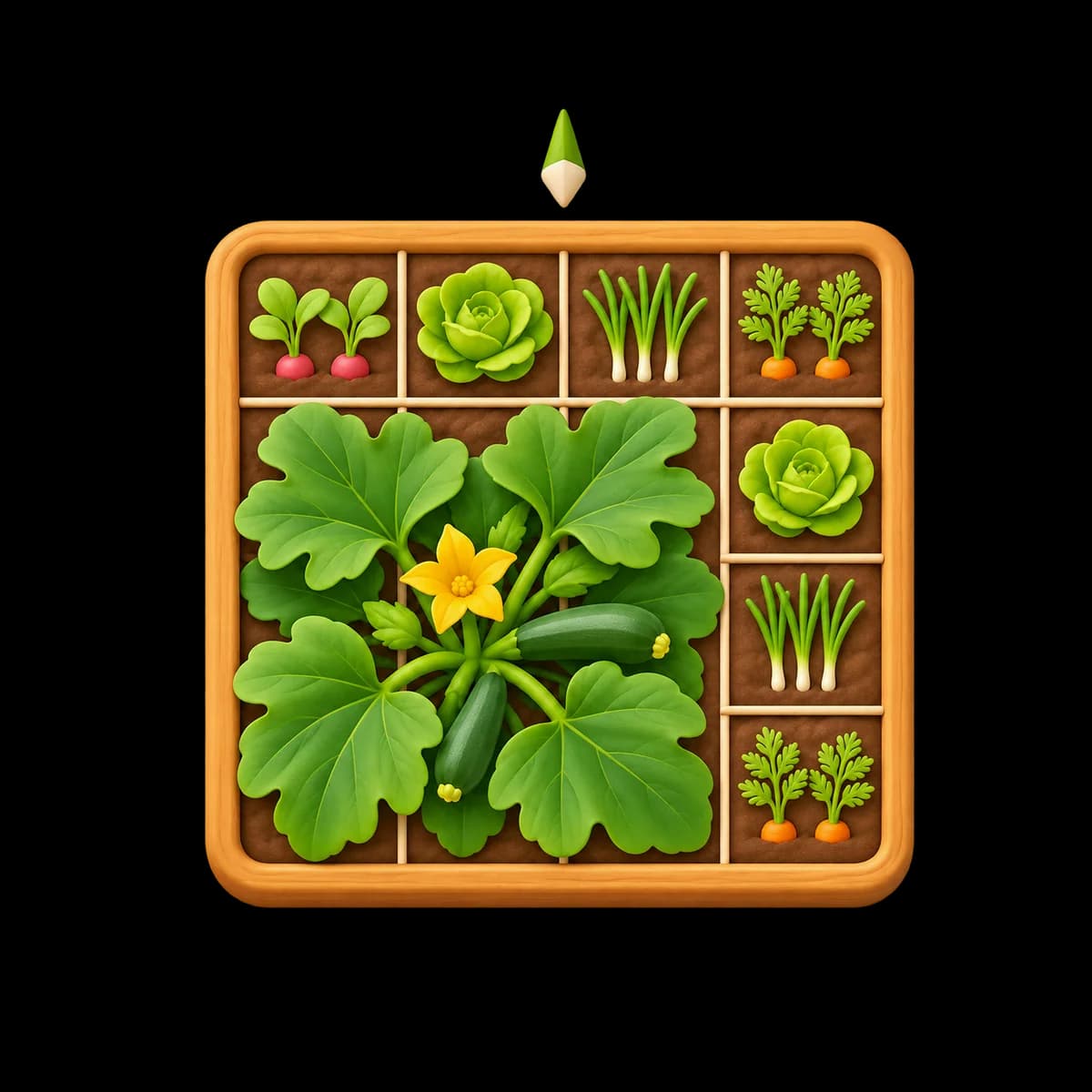
A single square works for small crops. Larger crops do not fit the 1-per-square end of the rule, and the gap shows up clearly when you set the grid against Sowstory's spacing:
| Crop | Sowstory spacing | 30 cm squares per plant |
|---|---|---|
| Bush courgette | 90 × 90 cm | 9 (a 3 × 3 block) |
| Outdoor cordon tomato | 60 × 60 cm | 4 (a 2 × 2 block) |
| Trained outdoor cucumber | 60 × 60 cm | 4 (a 2 × 2 block) |
| Kale, cauliflower, Brussels sprouts, sprouting broccoli | 60 × 60 cm | 4 (a 2 × 2 block) |
| Potatoes (first or second early) | rows 90 cm apart, 30 cm in the row | a row three squares wide, one tuber per square along it |
In practice, that means:
- Courgettes: one plant takes 9 of the 16 squares in a 4 × 4 bed. Sowstory plans no more than two in any bed.
- Square foot gardening tomatoes: a cordon tomato needs a 2 × 2 block in Sowstory's plans, so a 4 × 4 bed could hold four by area. Sowstory plans no more than three outdoor cordon tomatoes per bed. Our tomato spacing guide explains the reasons.
- Potatoes: Sowstory leaves a 90 cm strip per row so the soil can be drawn up into a ridge. In a 1.2 m wide bed that is one row of four tubers (120 ÷ 30 = 4).
- Height: the grid says nothing about shade. Sowstory puts tall crops, such as climbing beans, cordon tomatoes and trained cucumbers, on the north edge of the bed so they do not shade shorter crops, and it plans climbing beans as one cane row 45 cm wide.
Square foot gardening carrots and other root crops
Sixteen carrots per square puts them about 7.5 cm apart each way. Carrots also need depth: Sowstory checks for at least 30 cm of soil before it plans early carrots, and BBC Gardeners' World says most carrots need about 30 cm, with round or dwarf types for shallower containers. In a shallow grid bed, choose short-rooted carrots. Our how to grow carrots guide covers sowing and thinning.
Mel's Mix, depth and peat-free gardening in England
What goes in Mel's Mix
The Foundation describes Mel's Mix as equal thirds, by volume rather than weight, of coarse vermiculite, sphagnum peat moss (or coconut coir) and blended compost, and says Mel recommended combining five different composts. Its own example is a 4 × 4 ft bed 6 inches deep needing 8 cubic feet of mix. In metric, a 1.2 × 1.2 m bed takes 216 litres at 15 cm deep and 432 litres at 30 cm.
The peat question
Classic Mel's Mix uses peat moss, and the Foundation lists coir as a substitute. In England, the government announced in August 2022 that peat sales to amateur gardeners would end by 2024, but the ban has not yet been made law. The RHS notes that no legislation currently bans peat, and from January 2026 plants sold in its own shops must be grown peat-free. The RHS describes peat-free composts as made from wood fibre, coir, composted bark and green waste. For a square foot bed in England, use the coir version of the mix or a good peat-free compost. Our guides to raised bed soil and how to fill a raised bed cover the alternatives.
How deep?
Square foot gardening is often associated with a very shallow bed: Wikipedia reports that Bartholomew claimed good results with only 6 inches (15 cm) of Mel's Mix. The Foundation pages we checked did not give a recommended depth. For vegetables, the RHS says about 30 cm is deep enough for salad leaves and that most plants need 45 cm or more. Sowstory checks for at least 30 cm before planning early carrots and first early potatoes, and 20 cm for radishes. See how deep a raised bed should be.
Square foot gardening in the UK: what to adapt
- Use 30 cm squares and measure the bed inside the frame.
- Fill with a peat-free mix as above.
- Go deeper than 15 cm if you want carrots, parsnips or potatoes.
- Follow England's timing. Hardy crops such as radishes, lettuce and carrots can start from March. Tender crops (tomatoes, courgettes, cucumbers, beans and basil) go out only after frost risk has passed: the RHS gives the second half of May for southern England, the end of May for the Midlands, north-west England and Yorkshire, and early June for north-east England.
- Give it sun. The Foundation asks for 6–8 hours, and the RHS defines full sun as more than six hours of direct sun at midsummer.
Grid or rows: which layout to use
A square foot layout is a tidy way to grow a little of many small crops in a small space, and the grid makes it easy to see what goes where. Rows suit larger crops, beds with tall plants that need the north edge, and anyone who wants to know exactly how many plants of each crop fit. Our raised bed layout ideas show row plans for 4 × 4, 3 × 6 and 4 × 8 ft beds with every count worked out, and the plant spacing calculator has the per-square and per-metre figures.
Sowstory takes the row-based approach: it uses each crop's own row and plant spacing rather than a fixed grid, lays your bed out to scale with tall crops on the north edge, and tells you how many plants fit. It is coming soon to the App Store, and your first bed plan is free.
Sources
- Square Foot Gardening Foundation: History
- Square Foot Gardening Foundation: The method
- Square Foot Gardening Foundation: Mel's Mix resources
- Wikipedia: Square foot gardening
- GOV.UK: Sale of horticultural peat to be banned (27 August 2022)
- RHS: Peat-free compost choices
- RHS: Retail peat-free from 2026
- RHS: How to make a raised bed
- RHS: When to plant out tender plants
- BBC Gardeners' World: How to grow carrots
- Sowstory knowledge base, release v1.4