
A raised bed planner turns three things you know (the inside size of your bed, how much sun it gets and the crops you want) into a to-scale layout, plant numbers and a sowing timeline. You can do it by hand with a tape measure and a spacing chart, or let an app such as Sowstory do the arithmetic for England's growing season, with your first bed planned free.
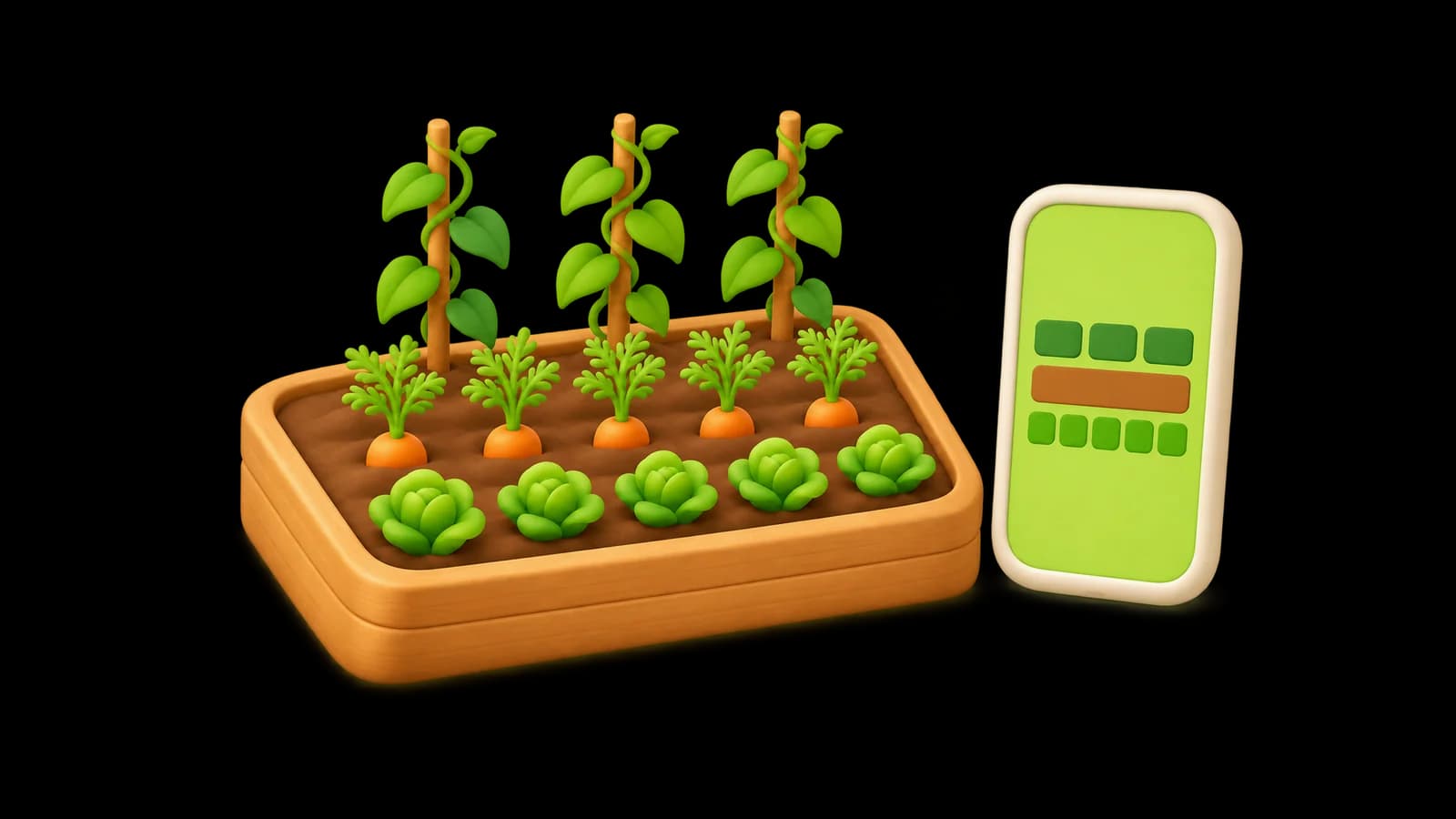
This guide shows what a good plan needs, walks through planning a bed by hand, gives an example planting scheme for a common bed size, and is honest about what the Sowstory app does and does not do yet.
What a good raised bed plan includes
Whether you use paper, a spreadsheet or an app, a plan that works in the soil covers six things:
- Real inside measurements. The frame takes up space, so measure inside the timber. Our guide to raised bed sizes explains the widths that are easy to reach.
- Spacing per crop. Each crop needs its own gap between rows and between plants. Carrots can sit in rows 20 cm apart; a bush courgette needs a square of about 90 × 90 cm. The vegetable spacing chart lists them.
- Height and shade. Tall crops cast long shadows. Sowstory places climbing beans, cordon tomatoes, trained cucumbers, tall kale and other tall crops on the north edge of the bed.
- Sun. Most fruiting crops want six or more hours of direct sun. Leafy crops such as lettuce, spinach, chard and parsley tolerate four to six hours.
- Timing. A bed is not one snapshot. Garlic occupies its space from autumn into the following summer; radishes are in and out within about two months. A plan should show when each space is busy.
- Depth. Long-rooted crops need deeper soil. Sowstory checks a minimum depth for a few crops, such as 30 cm for early carrots and first early potatoes; see how deep a raised bed should be.
How to plan a raised bed by hand
1. Measure the growing area
Measure the inside length and width in centimetres and note the soil depth. Sketch the bed on squared paper at a simple scale, such as one square for 10 cm.
2. Mark north and note the sun
Draw an arrow for north. Count roughly how many hours of direct sun the bed gets in summer. A bed in shade for half the day suits leafy crops better than tomatoes.
3. Choose crops, then check spacing
List what you want to eat, then look up each crop's row and plant spacing. Be realistic: a single courgette plant can claim most of a small bed. The plant spacing calculator shows how many plants of each crop fit common bed sizes.
4. Place tall crops on the north edge
Put anything that climbs or grows tall along the north side, then step down in height towards the south so every crop gets light.
5. Draw rows along the long edge
On a typical bed, rows along the length are easier to reach and give you fewer, longer rows. Leave the stated gap between rows; that gap is what lets you weed, water and harvest.
6. Add the timing
Write the sowing or planting month beside each crop, using a vegetable sowing calendar for England. Mark what can follow a quick crop once it is cleared.
An example planting scheme for a 1.2 × 2.4 m bed
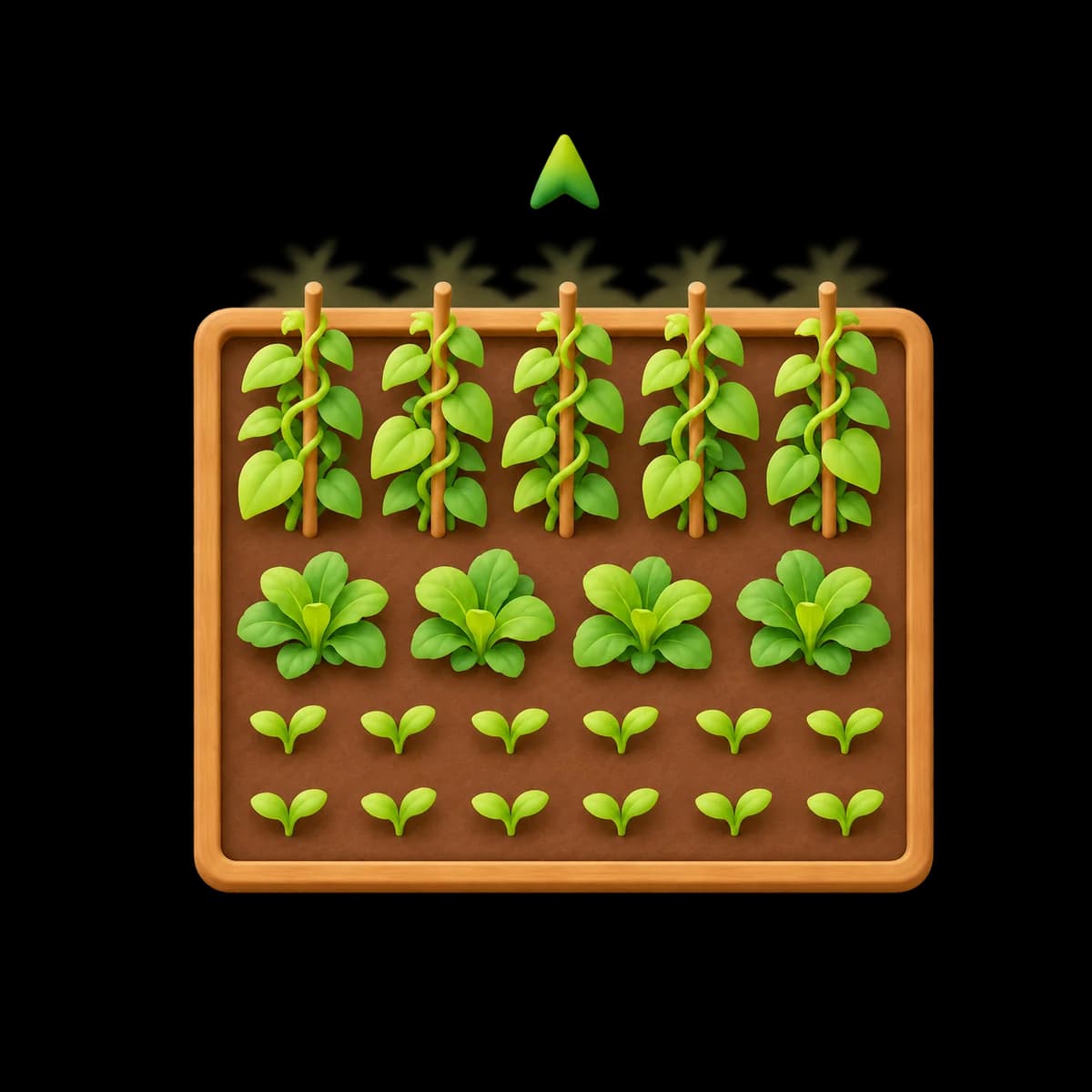
Here is a simple summer scheme for a 1.2 × 2.4 m bed (about 4 × 8 ft) in full sun, drawn by hand with the spacings Sowstory uses. Rows run along the 2.4 m length.
| Position (north to south) | Crop | Width used | Rough plant count along 2.4 m |
|---|---|---|---|
| North edge | Runner beans on one cane row | 45 cm | about 9 plants at 25 cm apart |
| Middle | Beetroot, one row | 30 cm | about 24 plants at 10 cm apart |
| South side | Early carrots, two rows | 2 × 20 cm | about 48 roots per row at 5 cm apart |
That uses 1.15 m of the 1.2 m width. The counts are simple estimates (length divided by in-row spacing). Sowstory's own layout also allows for the bed edges, so an app plan may show slightly fewer plants. For more schemes, including 4 × 4 ft and 3 × 6 ft beds, see our raised bed layout ideas.
"Raised bed plans": building versus planting
Many people searching for raised bed plans want carpentry plans for building the frame. This page is about planting plans. If you are still choosing a frame, start with the size and depth: a width you can reach across from both sides, and enough depth for the crops you want. Our guides to raised bed sizes and filling a raised bed cover the decisions that affect what you can grow.
Planning by hand versus a planner app
| Paper or spreadsheet | Sowstory app | |
|---|---|---|
| Cost | Free | First bed free; then £4.99 per bed or £14.99 season pass |
| Spacing | You look up every crop | Built in for 45 growing profiles of 35 crops |
| Tall crops and shade | You remember to check | Placed on the north edge automatically |
| Plant numbers | You do the arithmetic | Calculated for your exact bed size |
| Timing | Copy from a calendar | Month-by-month plan for England, with succession where supported |
| Notes and progress | Notebook | Optional private journal with up to 5 pictures per entry |
Paper is perfectly good for one familiar bed. An app earns its place when you are new to a crop, have an odd-sized bed, or want the numbers checked for you.
If you would rather not do the arithmetic, Sowstory will lay out your bed to scale, tell you how many plants or rows fit, and explain why it chose or left out each crop. It is coming soon to the App Store, and your first bed plan is free.
What Sowstory plans, and what it does not (yet)
- Crops: 35 vegetables and herbs as 45 growing profiles (for example, first early, second early and maincrop potatoes). It does not plan sweetcorn, squash or pumpkins, strawberries or trailing cucumbers yet.
- Place: outdoor raised beds in England. You enter your postcode so the plan is placed in England; the full postcode is not stored.
- Timing: sowing and planting windows are England-wide months. They are not yet adjusted to your local climate, and the app does not give a frost date for your address, so keep an eye on the weather. Our guide to last frost dates explains how to judge it.
- Spacing: planning allowances based on published guidance, often the more generous figure. Check your seed packet, as varieties differ.
Sources
- Sowstory knowledge base, release v1.4 (crop spacing, start months, tall-crop placement, depth checks)