
A vegetable garden planner, whether on paper, online or in an app, helps you decide where each bed goes, which crops go in it, how far apart to plant them and when to sow, so the plot stays productive from spring to winter. For a garden in England, a good plan starts with the sun and the paths, groups crops so they can move round each year, and uses real spacing and timing for each crop.
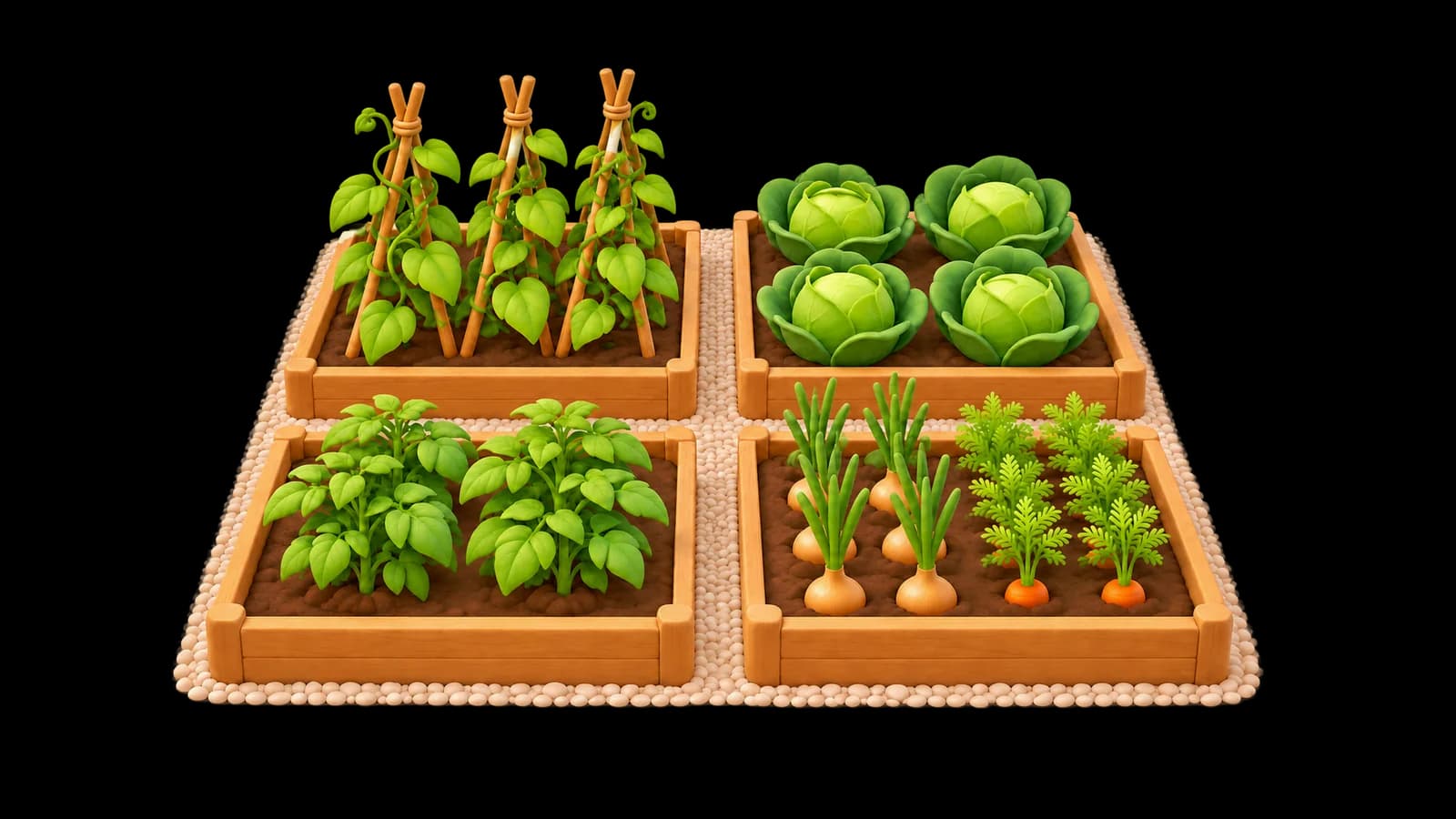
This guide walks through planning a vegetable garden step by step, then compares the three kinds of planner: paper, online tools for a whole plot, and apps such as Sowstory that lay out raised beds for you.
Step 1: Map the site
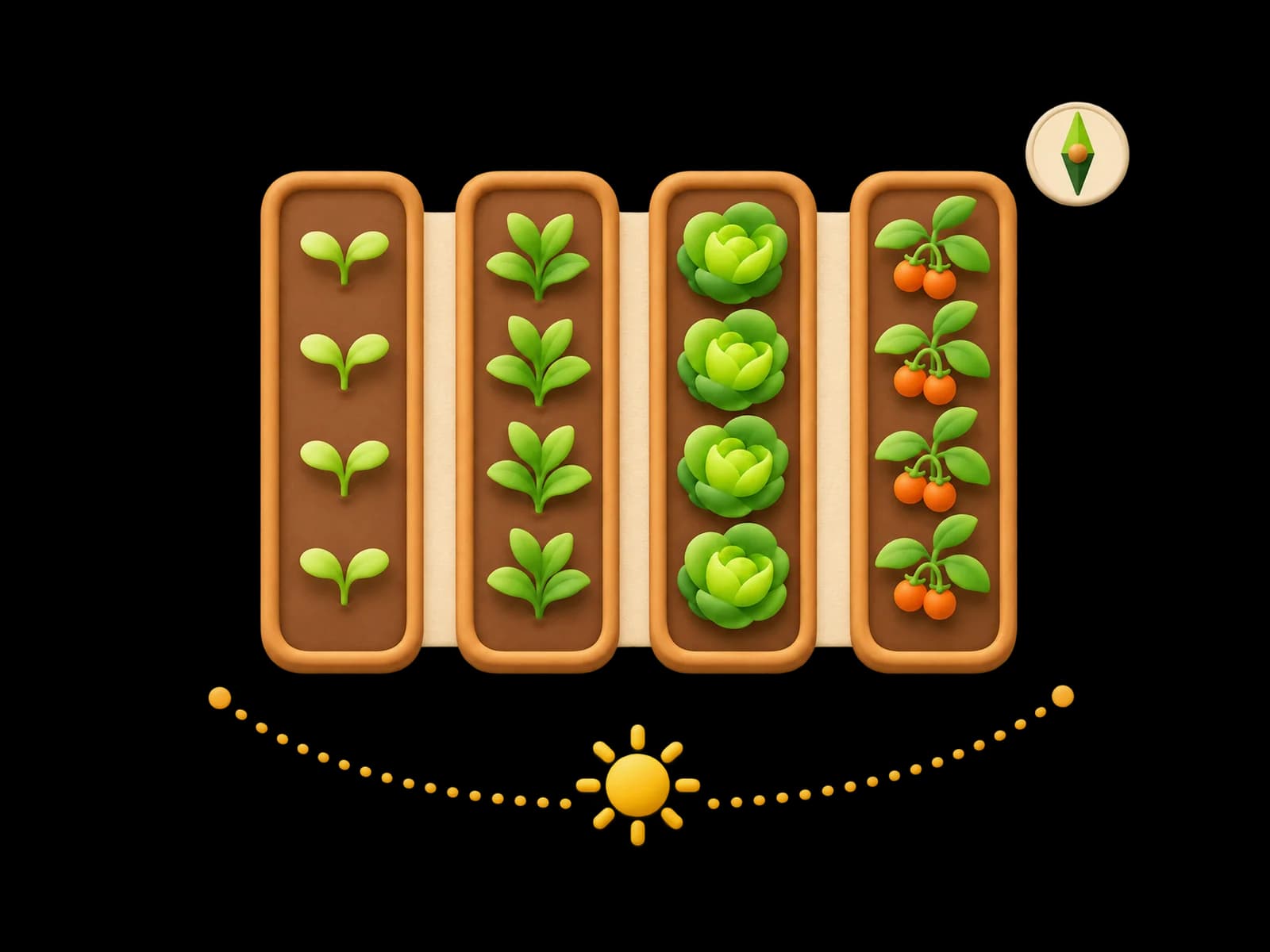
- Sun. Most fruiting vegetables want six hours or more of direct sun; leafy crops such as lettuce, spinach, chard and parsley cope with four to six. Note which parts of the garden get the most.
- Bed width. The RHS says beds under 1.5 m wide let you reach the middle without standing on the soil. See raised bed sizes for common sizes.
- Paths. Allow at least 45 cm between beds for a wheelbarrow, and at least 1 m if you need wheelchair access (RHS).
- Direction. The RHS suggests running long beds north to south for even light.
- Draw it to scale. The RHS recommends planning on scaled paper so you do not overcrowd the plot.
Step 2: Group crops so they can rotate
Soil pests and diseases tend to attack one plant family. Growing each family in a different bed each year lets them die down while their hosts are absent; the RHS names clubroot and onion white rot as examples. The RHS rotation groups are:
| Group | Crops |
|---|---|
| Legumes | peas, broad, French and runner beans |
| Brassicas | Brussels sprouts, cabbage, cauliflower, kale, kohlrabi, oriental greens, radish, swede, turnip |
| Onions | onion, garlic, shallot, leek |
| Potato family | potato, tomato |
| Roots | beetroot, carrot, celeriac, celery, Florence fennel, parsley, parsnip |
Cucurbits (courgettes, cucumbers), salads and sweetcorn can go wherever is convenient, as long as they do not stay in one spot too often. The RHS's three-year plan moves potatoes, then legumes, onions and roots, then brassicas round three equal areas. With four raised beds, the RHS four-year order is legumes, brassicas, potatoes, then onions and roots. Rotation helps reduce problems but does not guarantee to prevent them. Our vegetable garden layout guide shows how to set this out over several beds.
Step 3: Space each crop properly
Overcrowding is the most common planning mistake. Each crop has its own gap between rows and between plants: early carrots can sit in rows 20 cm apart, while a bush courgette needs a square of about 90 × 90 cm. Use the vegetable spacing chart to check every crop, and put tall crops on the north edge of each bed so they do not shade the rest.
Step 4: Add the timing
Write down when each crop is sown, planted out and harvested. A bed is not a single picture: garlic planted in autumn holds its row into the following summer, while radishes are in and out within about two months, which leaves room for a follow-on sowing. Use a UK vegetable sowing calendar for the months, and plant tender crops out only once frost risk has passed in your area. The RHS notes that fleece can bring spring-sown crops forward by about two weeks, and a good cold frame by up to a month.
Choosing a garden planner
| Paper | Online planner for a whole plot | Sowstory (raised beds) | |
|---|---|---|---|
| Best for | One familiar plot | Allotments and large gardens | One or more raised beds |
| Layout | You draw it | You draw beds and drag in crops | Laid out for you, to scale |
| Spacing | You look it up | Calculated as you draw | Built in for 45 growing profiles |
| Timing | From a calendar | Usually adjusted to your location | England-wide months |
| Rotation | You track it | Often warns about repeats | Not across years yet |
| Platforms | Pencil | Web browser, some with apps | iPhone, coming soon |
| Cost | Free | Free tiers or trials, then paid | First bed free; £4.99 per bed or £14.99 season pass |
If you want a whole plot drawn in a browser, look at the planners in our best garden planning apps comparison. If your garden is a set of raised beds, a planner that does the layout for you saves the arithmetic. See our raised bed planner guide.
How Sowstory plans a garden of raised beds
Sowstory keeps all your beds together in one plot for your region of England, and plans each bed on its own:
- Enter a bed's inside size, how much sun it gets and your postcode (to place it in England; the full postcode is not stored).
- Choose the crops you like and any you want to avoid, your experience and your goal.
- Get a to-scale layout with every row and plant placed, tall crops on the north edge, the number of plants or rows that fit, the reason each crop was chosen or left out, and a month-by-month timeline.
- Keep an optional private journal for each bed, with notes and up to five pictures per entry.
If that is how you would like to plan, Sowstory lays out your first bed free when it arrives on the App Store.
Honest limits
- Sowstory plans outdoor raised beds in England, bed by bed. It does not draw lawns, paths or sheds.
- It plans 35 crops as 45 growing profiles. Sweetcorn, squash and pumpkins, strawberries and trailing cucumbers are not planned yet.
- It does not plan crop rotation across years yet, so use the table above to move crop groups between beds yourself.
- Timing is England-wide by month and not yet adjusted to your local climate; it gives no frost date for your address. See last frost dates in the UK.
Sources
- RHS: Raised beds
- RHS: Planning a vegetable garden
- RHS: Crop rotation
- RHS: Making the most of your allotment plot
- Sowstory knowledge base, release v1.4 (spacing, sun, tall-crop placement, crop list)