
A vegetable garden layout that works in a small English garden is usually two to four raised beds in the sunniest spot you have, each narrow enough to reach the middle from the paths, with long beds running north to south and paths at least 45 cm wide between them. Most gardeners build beds in winter, so they are ready for the first sowings in March.
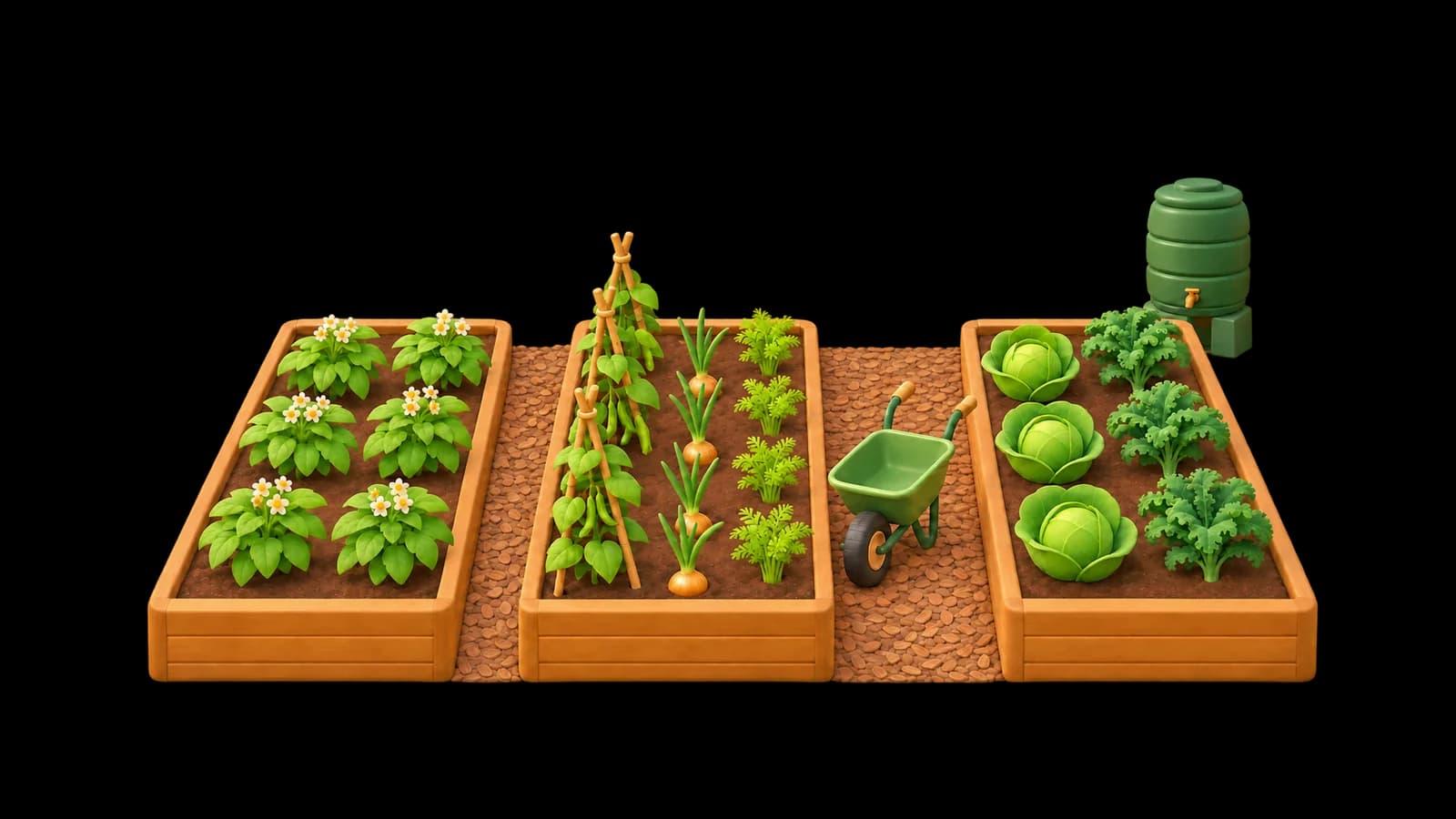
This guide covers where to put the beds, which way to run them, how wide to make the paths, a simple rotation between beds, and four small-garden plans with the sizes worked out.
Start with sun and shelter
Sun decides more than anything else what your beds can grow. The RHS says vegetables, fruit and cut flowers need full sun, so look for a south- or west-facing spot away from overhanging trees. It defines full sun as more than six hours of direct sun a day at midsummer, and partial shade as three to six hours.
Spend a sunny day noting when each part of the garden is in direct sun, then:
- Give the sunniest spot to fruiting crops. The RHS notes that fruiting crops suffer most in shade, and that tomatoes can struggle without all-day sun.
- Use part-shaded spots for leaves and some roots. The RHS lists beetroot, baby carrots, chard, kale, kohl rabi, leaf salads, lettuce, peas, runner beans and spinach as fairly tolerant of light shade.
- Keep clear of big trees and hedges. They shade beds and compete for water and nutrients.
- Look for shelter and water. BBC Gardeners' World suggests a level, sheltered site near a tap or water butt, and warns that beds against walls or fences can sit in a rain shadow and need more watering.
- Avoid frost pockets. Cold air runs downhill and collects at the lowest point or against a barrier such as a hedge or fence. The RHS advises against planting in these frost pockets.
Bed size and orientation
Keep each bed narrow enough to reach the centre without standing on the soil. The RHS puts that limit at under 1.5 m wide, and it suggests several smaller beds rather than one long run. Our guide to raised bed sizes compares common widths and lengths.
For orientation, the RHS advises running long beds north to south for even light: the sun reaches one long side in the morning and the other in the afternoon. Inside each bed, Sowstory follows its own rule of putting tall crops on the north edge, so they shade the path rather than shorter crops. In a north–south bed that edge is the short north end; in an east–west bed it is the whole north side. Our raised bed layout ideas show both rules at work, with row-by-row plans for 4 × 8, 3 × 6 and 4 × 4 ft beds.
Paths between beds
The RHS suggests paths at least 45 cm (18 in) wide so a wheelbarrow fits, and at least 1 m if anyone needs wheelchair access. On allotments it recommends permanent paths between beds with defined edges, covered with membrane or chipped wood. Because you work raised beds from the paths, you never need to tread on the growing soil.
Small vegetable garden layout plans
Before building, draw your plot to scale on squared paper; the RHS recommends this as the easiest way to avoid overcrowding. These four plans take the bed sizes as inside measurements and 45 cm paths between beds. The footprint excludes the frame timber and any path around the outside.
| Plan | Beds | Paths between beds | Footprint | Growing area |
|---|---|---|---|---|
| A. Two beds | 2 × (1.2 × 2.4 m) side by side | one 45 cm path | 2.85 × 2.4 m | 5.76 m² |
| B. Three-bed rotation | 3 × (1.2 × 2.4 m) side by side | two 45 cm paths | 4.5 × 2.4 m | 8.64 m² |
| C. Four squares | 4 × (1.2 × 1.2 m) in a 2 × 2 grid | 45 cm cross paths | 2.85 × 2.85 m | 5.76 m² |
| D. Narrow side return | 2 × (0.9 × 1.8 m) end to end | one 45 cm gap | 0.9 × 4.05 m | 3.24 m² |
Plan A, two 4 × 8 ft beds, is the simplest start for beginners: one bed for summer crops such as beans, tomatoes and salads, the other for roots, onions and garlic.
Plan B fits the RHS three-year rotation (see below), one group per bed. Run the beds north to south with the paths between them.
Plan C suits a square corner. Three squares can rotate, and the fourth can hold herbs or perennial crops, which the RHS suggests keeping in their own area.
Plan D fits a narrow strip along a fence. Check the sun first, and remember the rain-shadow warning: water a bed against a fence more often.
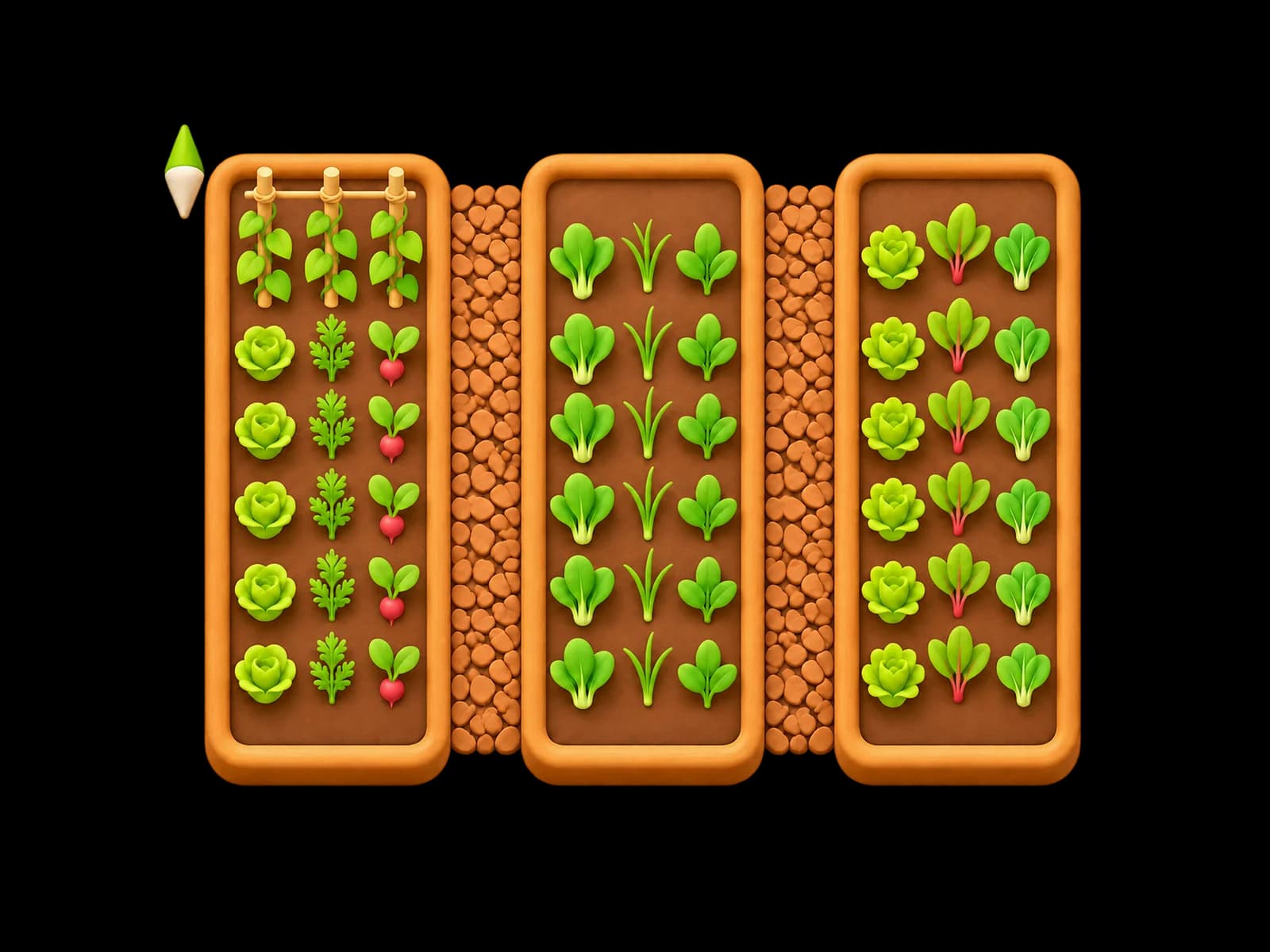
A simple crop rotation between beds
Crop rotation means growing each group of related vegetables in a different place each year. The RHS explains that many soil pests and diseases attack one plant family, so moving the family on lets them decline while their host is absent. It names clubroot (in brassicas) and onion white rot as examples. BBC Gardeners' World adds that growing potatoes in the same soil year after year lets pests such as potato eelworm build up.
The RHS rotation groups
- Potato family: potatoes and tomatoes.
- Legumes: peas and broad, French and runner beans.
- Onions: onions, garlic, shallots and leeks.
- Roots: beetroot, carrots, celeriac, celery, Florence fennel, parsley and parsnips.
- Brassicas: Brussels sprouts, cabbage, cauliflower, kale, kohl rabi, oriental greens such as pak choi, radishes, swedes and turnips.
- Anywhere: courgettes and other cucurbits, lettuce and other salads, and sweetcorn can go wherever is convenient, as long as they do not stay in one spot too often. Peppers and aubergines can also go anywhere.
A three-bed rotation plan
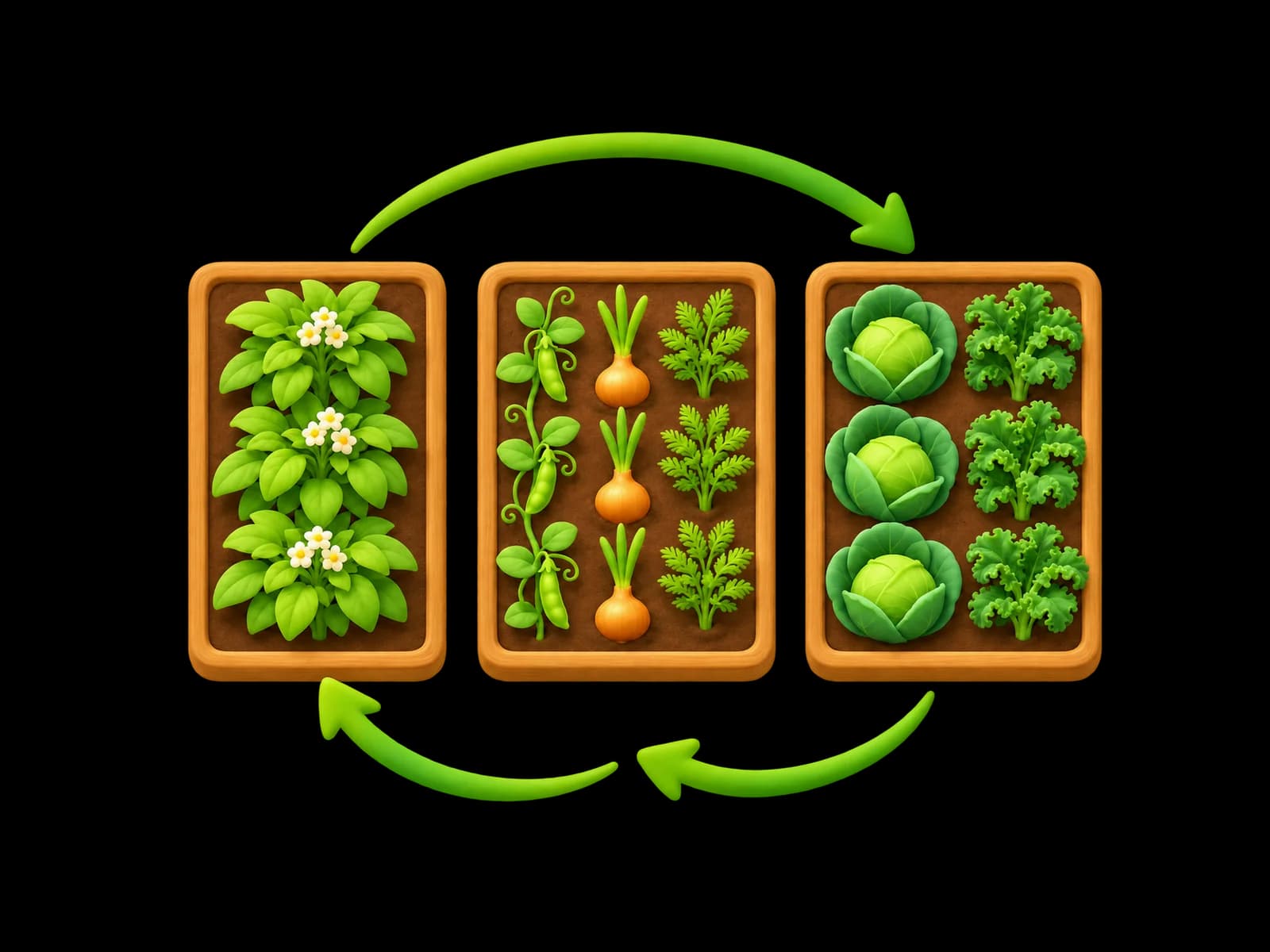
In the RHS three-year plan, legumes, onions and roots follow potatoes, brassicas follow legumes, onions and roots, and potatoes follow brassicas. With three beds it looks like this:
| Bed | Year 1 | Year 2 | Year 3 |
|---|---|---|---|
| Bed 1 | Potatoes and tomatoes | Legumes, onions and roots | Brassicas |
| Bed 2 | Legumes, onions and roots | Brassicas | Potatoes and tomatoes |
| Bed 3 | Brassicas | Potatoes and tomatoes | Legumes, onions and roots |
The RHS also gives a four-year version (legumes, then brassicas, then potatoes, then onions and roots), which suits Plan C if you give each square one group.
Rotation in small raised beds: what to expect
- It reduces problems; it does not prevent them. The RHS says rotation helps reduce pests and diseases. Clubroot spores can last up to 20 years in soil and onion white rot at least 15 years, so once either is present, rotation will not clear it.
- Very small plots are harder. The RHS says rotation suits all but very small vegetable gardens. We found no specific rotation advice for small raised beds, so treat the plan above as a sensible starting point, not a rule.
- Potatoes take a lot of width. Sowstory allows a 90 cm strip for a row of potatoes so there is room to earth them up. In a 1.2 m wide bed, that leaves about 30 cm for something quick such as a row of lettuce, which can go anywhere in the rotation.
- Fill gaps with quick crops. The RHS notes that intercropping and catch crops fit around a rotation. Sowstory reserves space for radishes for about eight weeks, and for loose-leaf lettuce and spring onions for about ten.
How Sowstory plans several beds
Sowstory groups your beds into one plot for your region of England, so all your beds sit together in the app. It plans each bed separately: you enter each bed's inside size, how much sun it gets, which edge faces north and the crops you like or want to avoid, and it lays out that bed to scale with a month-by-month timing plan.
To be clear about the limits: Sowstory does not plan crop rotation across years and will not move crop groups from bed to bed for you. Keep your own record of what grew where. The app's optional private journal for each bed, with notes and up to five pictures per entry, is one place to do that. Sowstory's sowing months are England-wide; they are not adjusted for your postcode, so you still judge the weather.
Your first bed plan is free and fully featured. Further beds are £4.99 each, or £14.99 for a season pass covering unlimited beds for 12 months, and editing a bed you have already planned is free.
If you would rather not draw every bed by hand, Sowstory will lay out each bed to scale, with tall crops on the north edge and a count of how many plants fit. It is coming soon to the App Store, and your first bed is free.
Planning what goes in each bed
Once the beds are in place, the next step is choosing crops and spacing them. Our list of what to grow in a raised bed picks 20 easy crops for England, the vegetable spacing chart gives row and plant gaps for each one, and the raised bed planner guide walks through planning a single bed by hand. For filling new beds, see how to fill a raised bed and our guide to raised bed soil.
Sources
- RHS: How to make a raised bed
- RHS: Shade gardening
- RHS: Positioning vegetables
- RHS: Crops for shade
- RHS: Planning a vegetable garden
- RHS: Allotments, making the most of your plot
- RHS: Crop rotation
- RHS: Club root
- RHS: Onion white rot
- RHS: Frost damage
- BBC Gardeners' World: How to make a vegetable patch
- BBC Gardeners' World: Gardening tips for raised beds
- BBC Gardeners' World: How to grow potatoes
- Sowstory knowledge base, release v1.4